

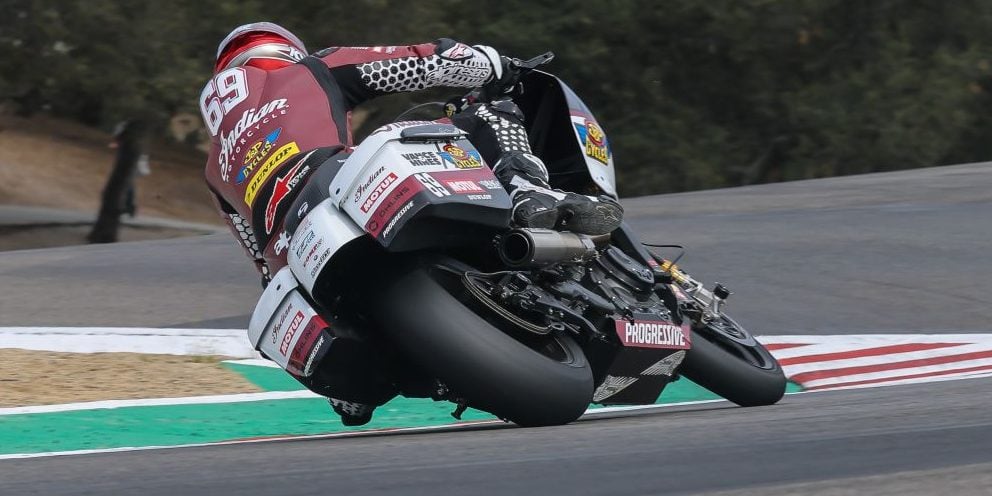
Hayden Gillim is doing it again. The J&P Cycles/Motul/Vance & Hines Factory Indian rider topped Friday qualifying at Mid-Ohio Sports Car Course, claiming provisional pole for the MotoAmerica Mission King of the Baggers round — and if you've been watching this series, that shouldn't surprise you. What should get your attention is the gap between what's happening at the front of that grid and what's sitting in your garage right now.
The Qualifying Results: Gillim, Herfoss, Wyman Lead the Field
Friday's King of the Baggers qualifying session at Mid-Ohio sorted out the front row fast. Gillim on the #69 factory Indian was quickest, with teammate Troy Herfoss slotting into second. Harley-Davidson x Dynojet Factory Racing's Kyle Wyman ran third, Rocco Landers fourth on another factory Indian, and James Rispoli of Big Diehl x Harley-Davidson Factory Racing rounded out the top five.
Two manufacturers, five riders, every one of them on machines that started life as touring bikes — the same platform you're riding. That's the whole point of this series, and it's worth sitting with for a second. These are not purpose-built race exotics. They are heavily developed versions of the same Milwaukee-Eight and PowerPlus-powered baggers that fill every dealership floor in the country. The delta between a stock touring machine and a King of the Baggers contender is almost entirely in the parts bolted to it.
Gillim topping the session for the second time — he also led Baggers practice earlier in the day at Mid-Ohio — tells you the factory Indian program has dialed in its setup at this track. But the broader story is what the Harley camp can do: Wyman in third and Rispoli in fifth mean the Harley-Davidson x Dynojet and Big Diehl programs are far from a footnote.
What Makes a King of the Baggers Machine Fast
If you watch the broadcast and wonder what separates a provisional pole machine from a stock Road Glide or Street Glide pulling out of your driveway, it comes down to a short list of high-leverage modifications. The engine, the exhaust, the intake, the suspension, the tuning — and the order in which you address those systems matters.
Power: The Engine Package
Every serious bagger build starts with displacement and airflow. The Milwaukee-Eight 117 is already a capable foundation, but race teams don't leave valve events or compression ratios stock. High-lift, high-duration camshafts are the first call — they transform the torque curve and pull the powerband higher without requiring you to tear the cases apart. A quality performance cam kit is the single highest return-on-investment internal engine mod you can make on a bagger. Pair that with head work — ported heads, larger valves, higher compression pistons — and you're building toward the kind of mid-range authority that shows up in corner exit speed, which is exactly where these races are won.
For riders who want to stay naturally aspirated, that cam-and-head combination is the ceiling of what a street build can realistically achieve without forced induction. If you're willing to go further, a bagger turbo kit changes the conversation entirely — but that's a different article.
Exhaust: Flow Is Free Horsepower
Nothing chokes a big V-twin faster than a restrictive exhaust. Factory catalytic converters and slip-on mufflers are emissions compliance hardware, not performance hardware. The race teams run full systems — header pipe diameter, collector design, muffler flow rate — tuned to the engine's specific displacement and cam timing.
On your street build, a full exhaust system is the move. Not a slip-on. Not a tip swap. A properly designed header-to-muffler system that matches your engine's breathing. Vance & Hines has been in the King of the Baggers paddock since day one — their exhaust development is informed directly by what wins races. When you bolt a race-pedigree pipe onto your Milwaukee-Eight, you're getting technology that was tested under Gillim and Wyman before it ever hit the street market.
Air Intake: Feed the Engine
An exhaust without a matching intake is a half-measure. Your engine is an air pump — restrict the inlet and you cap every other modification you've made. A high-flow performance air cleaner designed for the Milwaukee-Eight opens up the intake tract and, critically, gives your tuner something to work with. The filter medium, the housing volume, the inlet design — all of it affects how the engine responds across the RPM range, not just at peak.
This matters especially if you've already done exhaust work. A mismatched combination — free-flowing exhaust, stock intake — leaves power on the table and can produce lean conditions that your tune has to fight around.
Suspension: The Part Most Street Riders Ignore
Watcher Wyman hold his third-place position through Mid-Ohio's sweeping corners and you'll notice the bike is tracking, not wallowing. Stock touring suspension is calibrated for load-bearing comfort over long distances with a passenger and luggage. It is not calibrated for cornering forces at race speeds, and it's not calibrated for aggressive solo street riding either.
Replacing the rear with properly valved performance bagger shocks transforms how a touring bike handles. Spring rate, damping compression and rebound — dialing those numbers into your weight and riding style means your tire stays in contact with the pavement under hard cornering and hard braking instead of skating across it. The front end matters too: progressive springs or a cartridge kit in the fork legs give you consistent brake dive control and feedback that stock springs simply can't deliver.
The riders on that Mid-Ohio grid aren't fighting their bikes through the corners. Their suspension is doing the work. Yours should too.
Tuning: Where All of It Comes Together
Here's the piece most builders rush past: without a proper tune, every part you've bolted on is running on a fuel map that was written for a stock engine. Harley-Davidson's factory ECU calibration accounts for the widest possible variation in altitude, fuel quality and operating temperature. It is not optimized for your specific combination of cam, exhaust and intake.
A dyno tune — whether through Dynojet's Power Vision platform or a comparable solution — rewrites the fuel and ignition tables for your exact engine in your exact configuration. The difference between a bolted-on part and a bolted-on-and-tuned part is often 10 to 15 percent more usable power, better throttle response and cleaner idle. The factory Harley teams run Dynojet hardware at the race level for a reason: precision fueling is non-negotiable when every tenth of a second counts.
For the street, a fuel tuner or a professional dyno session is the mandatory final step on any performance build. Don't skip it.
The Harley vs. Indian Storyline at Mid-Ohio
Gillim and Herfoss going 1-2 in qualifying keeps the factory Indian program on top of the timing sheets, but Wyman's third and Rispoli's fifth mean the Milwaukee fight back is real. Dynojet's involvement with the Harley program isn't just a sponsorship decal — their tuning hardware and data acquisition give the Wyman crew the same level of ECU precision the Indian camp has been exploiting.
For what it means to you as a Harley rider: this competition is good. Every time the Indian program leads qualifying, the Harley development teams push harder. Every hard part, every calibration update, every suspension tweak that emerges from that paddock eventually influences what's available to the street market. The King of the Baggers series is effectively a very expensive, very public R&D program for the touring segment — and the parts that survive it end up on your bike.
Watch how the race plays out Sunday. Provisional pole doesn't always translate to a race win, especially at a technical track like Mid-Ohio where chassis balance and corner-entry confidence can offset raw qualifying pace. Wyman and Rispoli have both shown they can close on the front runners when the green flag drops.
What to Take from Mid-Ohio Back to Your Garage
Pole position in King of the Baggers qualifying isn't a marketing event — it's the result of thousands of hours of engineering decisions made by people who understand the Milwaukee-Eight and the PowerPlus platform at a molecular level. When you watch Gillim on that #69 Indian or Wyman threading the Road Glide through Mid-Ohio's esses, you're watching a proof of concept for what a properly built touring bike is capable of.
Your build doesn't need a race budget. It needs a priority list: cam and exhaust first, intake to match, suspension to support the chassis, tune to tie it all together. Each one of those upgrades makes your bike faster, more responsive and more confidence-inspiring — on a Sunday morning canyon run or an open-road blast between stops, not just on a race circuit.
Gillim's provisional pole at Mid-Ohio is the headline, but the real story is what the King of the Baggers series keeps proving: a touring bagger, built right, is one of the most capable performance machines on the road. Start with a race-proven performance exhaust system and back it up with a properly matched high-flow air cleaner to start unlocking what your Milwaukee-Eight is actually capable of. Then work your way through cams, suspension and fueling on the same path the factory teams take. Shop our bagger performance parts collection and our Milwaukee-Eight cam kits at vtwinbikers.com — the same category of components that are putting riders on provisional pole right now.