

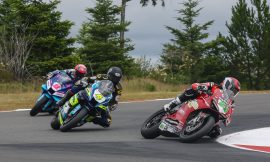
Five MotoAmerica feature classes are descending on Mid-Ohio Sports Car Course this weekend, and every single point on that 2.4-mile, 15-turn circuit matters. If you've been watching the King of the Baggers standings tighten round by round, you already know — the home stretch of this season is where championships are won or thrown away. This is the moment that separates the builds that look fast from the machines that actually are.
Why Mid-Ohio Changes Everything for Bagger Racing
Mid-Ohio Sports Car Course is not a straightline shootout. At 2.4 miles and 15 turns, it rewards complete machines — bikes that can lay down serious horsepower AND carry corner speed without washing the front end into the gravel. For King of the Baggers competitors, that means the setups being run this weekend represent the sharpest edge of what a production-based touring bike can do in competition.
The course forces engineers and tuners to solve problems that most street riders never think about: chassis flex under hard braking, suspension compliance through elevation changes, power delivery that doesn't overwhelm rear traction mid-corner. Every solution those race teams cook up eventually finds its way into the parts available to you. That's the direct line between MotoAmerica paddock development and the bolt-ons sitting in your garage.
If your Road Glide or Street Glide is still running stock suspension trying to keep pace with anything on a twisty road, this is the moment to pay attention. The performance bagger shocks that make a difference at Mid-Ohio are the same ones that will transform your bike on your favorite canyon road.
Five Classes, Five Championship Battles Worth Watching
The source text confirms five of MotoAmerica's feature classes are in action this weekend. While King of the Baggers draws the most attention from the touring-bike faithful, the full card means the entire spectrum of American performance motorcycle racing is on display at one venue. Middleweight machines, heavyweight baggers, production-based twins and high-horsepower hooligan builds — Mid-Ohio is getting all of it.
For the bagger community specifically, watching these races is more than entertainment. It is a live dyno session for the entire industry. Teams running full-exhaust systems tuned for race fuel and maximum flow are proving out header designs and collector geometry under conditions no street test could replicate. When a tuner pulls a bike to the dyno wall between sessions, the data they gather shapes the next generation of aftermarket pipes hitting the market.
What the Bagger Class Demands From a Build
King of the Baggers rules require competitors to start with a production touring chassis — no purpose-built exotics. That means a Milwaukee Eight powerplant, a frame with Harley-Davidson geometry, and fairings that at least nod toward street-legal bagger proportions. Within those constraints, teams have chased every legal pound of weight savings and every legal horsepower gain available.
The engine work alone is a masterclass in what the Milwaukee Eight platform can support. Big-bore kits pushing displacement well beyond the stock 114 or 117 cubic inches, aggressive cam profiles timed for peak mid-range torque, and air cleaner setups that flow enough volume to feed a motor making race-level power — these are not theoretical combinations. They are being proven at circuits like Mid-Ohio right now. A performance M8 cam and a properly matched high-flow air cleaner are the starting point for any serious Milwaukee Eight build, and what you're watching race at Mid-Ohio is the proof of concept.
The Championship Math at This Point in the Season
With the season entering its home stretch, the points picture in every MotoAmerica class is tightening. A single mechanical failure, a crash in turn one, a missed setup call on tire pressure — any of it can flip a points lead. For the riders in contention, Mid-Ohio is not a round to manage. It is a round to attack.
That mentality matters to the performance bagger community because it drives development decisions in real time. When a team needs more drive coming off slow-speed corners to make up time, they are not reaching for stock components. They are leaning on the same aftermarket suppliers — the same brands whose parts are available for your build. The fuel management and tuning systems keeping race engines on the razor's edge of air-fuel ratio under varying throttle inputs are production-derived units, tuned harder than any street map but built on the same platform your bike runs.
Chassis and Suspension: The Part Most Builds Get Wrong
Strip away the horsepower conversation for a second and focus on what actually lets a bagger carry speed through Mid-Ohio's 15 turns: chassis control. Factory suspension on a touring bike is engineered for two-up loaded highway comfort. It is not engineered to resist dive under race braking or maintain consistent geometry through a sequence of S-turns at pace.
Race teams rebuild their front ends with components that control damping and spring rate precisely. The rear suspension gets the same treatment. For your build, that translation is direct — if you want your Road Glide or Street Glide to feel planted rather than wallowing in corners, the suspension upgrade is not optional. It is the foundation everything else sits on. Investing in rear shocks for your touring bike and a proper front-end rebuild pays dividends in confidence and control that no amount of extra horsepower can replace.
Braking is the other chassis element Mid-Ohio highlights. The circuit has heavy-braking zones where a bagger with upgraded pads, braided lines and proper rotor mass will carry more corner entry speed than one running stock hardware. Performance brake pads are one of the highest return-on-investment upgrades available for a street bagger that sees any real riding — the stopping improvement is immediate and the price is not exotic.
Engine Mods the Race Results Keep Validating
Every King of the Baggers season adds to the body of evidence about what Milwaukee Eight combinations actually make the bike faster at the track. Some of those lessons are expensive — exotic cylinder heads, custom crankshafts, roller-bearing upgrades. Others are directly accessible for a street or track-day build.
The exhaust system is the clearest example. Race baggers run full exhaust setups optimized for peak flow across the entire RPM range the motor will see in competition. Those designs filter into production aftermarket pipes that bolt onto your bike without custom fabrication. A performance exhaust for your Milwaukee Eight is not just about sound — it is about removing one of the biggest flow restrictions the factory installs, and on a motor that responds strongly to breathing improvements, the difference on the dyno is real.
Pair that exhaust upgrade with a Stage 2 or Stage 3 cam kit matched to your displacement and riding style, and you have addressed the two highest-leverage mechanical modifications available on a bolt-together budget. Add a tune — either a handheld unit or a professional dyno session — and your bike is a fundamentally different machine than it was when it left Milwaukee.
How to Watch and What to Take Away
MotoAmerica broadcasts are available for fans who want to watch the Mid-Ohio rounds live or on replay. If you are serious about your own build, watch the King of the Baggers races specifically with a technical eye. Pay attention to how the bikes behave under braking. Watch the corner exits — which machines are getting drive early and which are fighting wheelspin. Look at the lines riders choose and how chassis behavior is influencing those choices.
This is not passive spectator content. It is a free education in what makes a performance bagger work at the limit, taught by the fastest riders and most serious tuners in the country. The gap between what you see on track and what you can replicate on your own build is smaller than you think — the parts exist, the knowledge is available and the results are right there on your television screen.
Mid-Ohio is the pressure test for every championship contender in every class this weekend. For the bagger community, it is also the best argument for what your build could become with the right components underneath it.
Ready to close the gap between your Street Glide and what you're watching race at Mid-Ohio? Start with the fundamentals — exhaust, cams, suspension and fueling — and build from there. Shop our performance exhaust collection and touring suspension upgrades at vtwinbikers.com and put race-proven thinking to work on your own machine.