

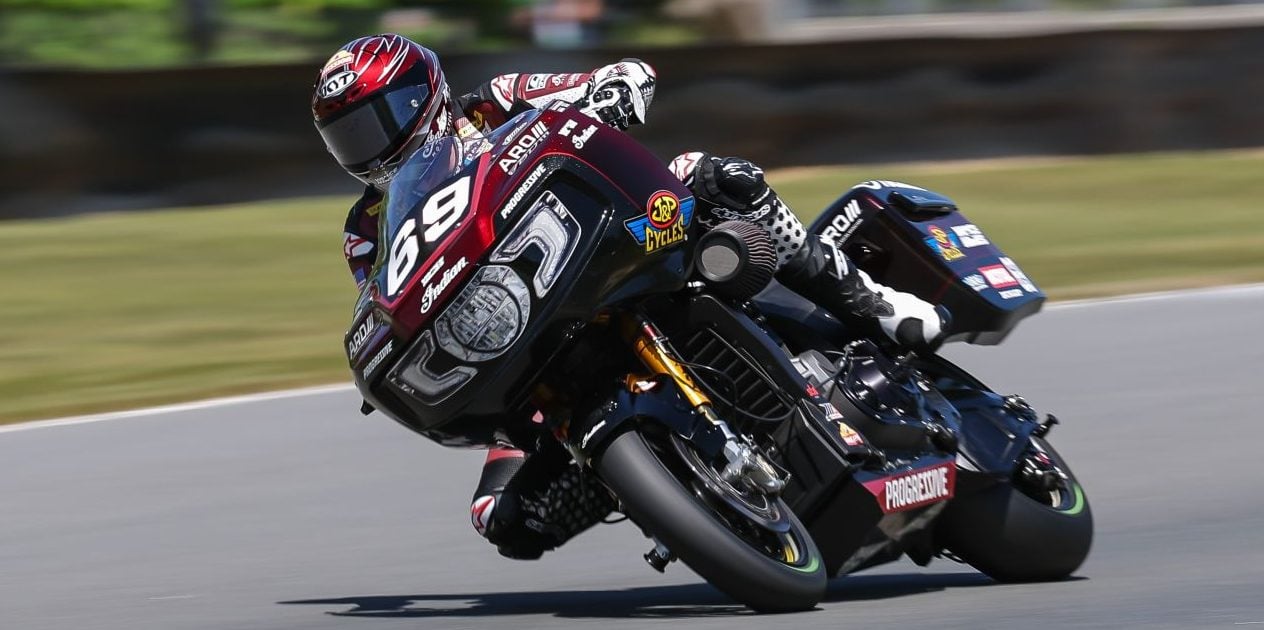
Hayden Gillim strapped into his Factory Indian and went to work at WeatherTech Raceway Laguna Seca on Friday — and when the session ended, his name was at the top of the MotoAmerica Mission King of the Baggers timing sheet. If you've been watching this series and wondering what separates the podium machines from the also-rans, practice sessions like this one are where the answers live. The hardware, the tuning, the suspension calibration — it all shows up when you're threading a 700-pound touring bike through the Corkscrew at race pace.
The Practice Sheet: Indian 1-2-3 With Rispoli Keeping Harley Honest
The top five from Friday's King of the Baggers practice at Laguna Seca broke down like this: Gillim led the session on the Factory Indian, with teammates Bradley Smith and Kyle Wyman slotting in second and third. Indian's Troy Herfoss ran fourth, and Big Diehl x Harley-Davidson Factory Racing's James Rispoli rounded out the top five.
That's a dominant showing by the Indian camp — four of the top five on the same platform — but Rispoli's presence in fifth matters. Harley-Davidson's factory bagger operation doesn't show up to Laguna Seca to make up numbers. Rispoli is a proven road racer, and the factory Harley program has been steadily closing gaps throughout the MotoAmerica King of the Baggers season. One practice session doesn't define the weekend. Qualifying and race day will tell the full story.
What this practice result does tell you is that the Vance & Hines exhaust program on the Factory Indians is working. Vance & Hines has been a cornerstone of the Indian factory effort in King of the Baggers from the beginning, and the exhaust note coming out of those race bikes tells you everything you need to know about what proper flow does for a big V-twin. If your own touring bike is still running the stock mufflers, you're leaving horsepower on the table that even a Friday practice session wouldn't forgive. A Vance & Hines performance exhaust is one of the highest-return bolt-ons you can run on a Milwaukee Eight — more flow, a real power increase across the mid-range and top end, and a sound that reminds you why you ride a V-twin in the first place.
What Makes Laguna Seca a True Bagger Test
WeatherTech Raceway Laguna Seca is not a forgiving track. It is 2.238 miles of elevation change, blind corners, a decreasing-radius Turn 2 that punishes late braking, and the Corkscrew — one of the most demanding corner complexes in American road racing. When you're piloting a full-size bagger through it at race pace, every component on that bike is working at its absolute limit.

Suspension is where baggers live or die at a track like Laguna Seca. The elevation changes are severe — the Corkscrew drops roughly 59 feet in elevation in just two corners — and the transitions happen fast. A factory-tuned bagger running proper race suspension can handle that. A street touring bike on OEM shocks cannot. The factory teams are running fully adjustable, race-valved suspension front and rear, and it shows in the corner speeds they carry through sections that would have a stock bagger's chassis completely overwhelmed.
For your street build, this translates directly: if you've upgraded the engine and exhaust but haven't touched the suspension, you've built a bike that makes more power than its chassis can use. A set of quality performance bagger shocks changes how your Road Glide or Street Glide communicates with you — better feedback, better cornering confidence, and a ride quality that doesn't beat you up on a long run to the track.
Braking is the other Laguna Seca variable. The run from the start-finish line into Turn 1, and the late-braking opportunities into Turn 2 and Turn 9, demand serious stopping power. The factory teams are on race-compound brake pads with premium rotors, and they're modulating brakes at forces that would have a stock bagger's brake system fading within a few laps. High-performance brake pads are a safety-and-performance upgrade that pays off both on the track and on the street — better bite, better modulation, better fade resistance when you're working the brakes hard on a canyon road or a mountain pass.
Vance & Hines and the Factory Indian Program
The J&P Cycles/Motul/Vance & Hines team name tells you a lot about how a top-tier King of the Baggers effort gets built. Vance & Hines isn't just a decal on the fairing — they are the exhaust and engine program behind the Factory Indian machines. The race bikes that Gillim, Smith and Wyman are running at Laguna Seca represent the furthest development of what Vance & Hines has learned through years of King of the Baggers competition, and that knowledge flows downstream into the street performance parts they produce.
The exhaust on a King of the Baggers race bike is a full race system — headers, mid-pipe and muffler engineered as one unit to maximize scavenging, minimize back pressure and hit the power curve at exactly the right points in the RPM range. That same engineering philosophy goes into the Vance & Hines street exhaust systems that you can bolt onto your touring bike. Race-developed, street-legal, and proven by some of the fastest bagger pilots in the country.
Pair a performance exhaust with a quality performance air cleaner and a proper tune, and you've built a breathing system that actually lets your Milwaukee Eight do what it was designed to do. The stock airbox and exhaust are calibrated for emissions compliance, not performance. The factory teams aren't running either — and neither should your build if performance is the goal.
Engine Internals: What the Race Bikes Tell Us About Cam Selection
Gillim's Factory Indian is not running stock camshafts. It's not running stock pistons, stock porting or a stock tune. King of the Baggers rules require the use of production-based V-twin engines, but within those rules there is significant room for internal development — and the factory teams exploit every inch of it.
For street Milwaukee Eight builds, the single highest-impact internal modification is camshaft selection. The right cam profile moves the power curve to where you actually ride — more torque in the mid-range, a stronger pull from 2,500 RPM through the top of the rev range, and better throttle response in every gear. If you're running a stage one (exhaust and air cleaner) and you've hit the tuner, the next call is cams. A well-chosen set of Milwaukee Eight performance cams transforms a strong stage one into a bike that feels like a completely different animal.
The cam choice also determines what your heads need. Lift and duration specs drive the conversation about valve springs — run too much lift on stock springs and you're asking for valve float and potential engine damage at higher RPM. When you go to cams, have the conversation with your builder about upgrading the valve spring package at the same time. It's cheap insurance against an expensive teardown.
Harley-Davidson's Factory Program: Rispoli Keeps the Pressure On
James Rispoli finishing fifth in practice for Big Diehl x Harley-Davidson Factory Racing is not a disaster — it's a Friday session at a technically demanding track. But it does reflect a pattern that's played out through much of the King of the Baggers era: the Indian factory effort has strong machinery, and the Harley factory program is in a constant development race to close the gap.
What the Harley factory program represents for street riders is a direct signal about where Milwaukee Eight performance ceiling is. The factory engineers and the aftermarket — S&S Cycle, Screaming Eagle, Vance & Hines on the Harley side — are continuously pushing what a Milwaukee Eight touring engine can do. The parts that show up in the performance aftermarket are filtered through that same development cycle.
If your build is centered on a Milwaukee Eight 114 or 117, the aftermarket has never been better. Cylinder kits, cam packages, fuel management, exhaust — the ecosystem is mature, proven, and race-developed. A fuel management tuner is the piece that ties all of it together: without a proper tune, you're not realizing the full benefit of any bolt-on upgrade. Every exhaust, every cam, every air cleaner works better when the fueling map is dialed in to match.
Race Day Outlook: What to Watch at Laguna Seca
Practice results at Laguna Seca establish pecking order, but they don't predict race results with certainty. The King of the Baggers grid has enough talent and enough development happening across multiple teams that a single session can be misleading. What matters is race pace — the ability to carry consistent lap times over a full race distance while managing tire wear, brake fade and chassis stability.
Gillim and the Factory Indian teammates running 1-2-3 in practice suggests that team has found a setup that works at Laguna Seca's unique combination of elevation, surface and corner types. Whether that translates to a race win is what Saturday and Sunday are for. Rispoli and the Harley factory camp will be working through the data from Friday's session, and it would be a mistake to count them out before a wheel has turned in anger on race day.
Watch the braking zones at Turn 2 and Turn 9 — those are the passing opportunities at Laguna Seca, and a rider willing to outbrake a competitor into those corners can make up significant ground from wherever they qualify. In King of the Baggers racing, the bravest brake marker and the best-setup chassis usually end up on the podium together.
Build Your Bagger Like the Race Teams Do
Every lap that Gillim, Rispoli, Smith, Wyman and Herfoss turn at Laguna Seca is a data point about what it takes to make a touring bagger go fast. The factory teams run the best exhaust, the best suspension, the best braking systems and the best engine internals available — because at race pace, every component matters and marginal gains stack up into podium finishes.
Your street build doesn't need to be a race bike, but it deserves the same philosophy: start with the best parts available, match them to each other, tune the result, and ride it hard. Shop our Vance & Hines exhaust collection at vtwinbikers.com for race-developed pipe systems built for Milwaukee Eight touring bikes, and browse our full performance bagger parts catalog to find the cams, suspension upgrades, air cleaners and fuel management solutions that will close the gap between your street bike and what the factory teams are running at Laguna Seca.