

Archie McDonald just proved that bagger racing on the world stage is no longer an American-only conversation — and the Silverstone Circuit in England was the place he made that statement loudest. The Australian rider aboard his Joe Rascal Racing Harley-Davidson crossed the line first in Race 2 of the FIM Harley-Davidson Bagger World Cup, beating teammate Eric Granado by 0.757 second in a seven-lap battle that had the Silverstone crowd on edge all the way to the flag.
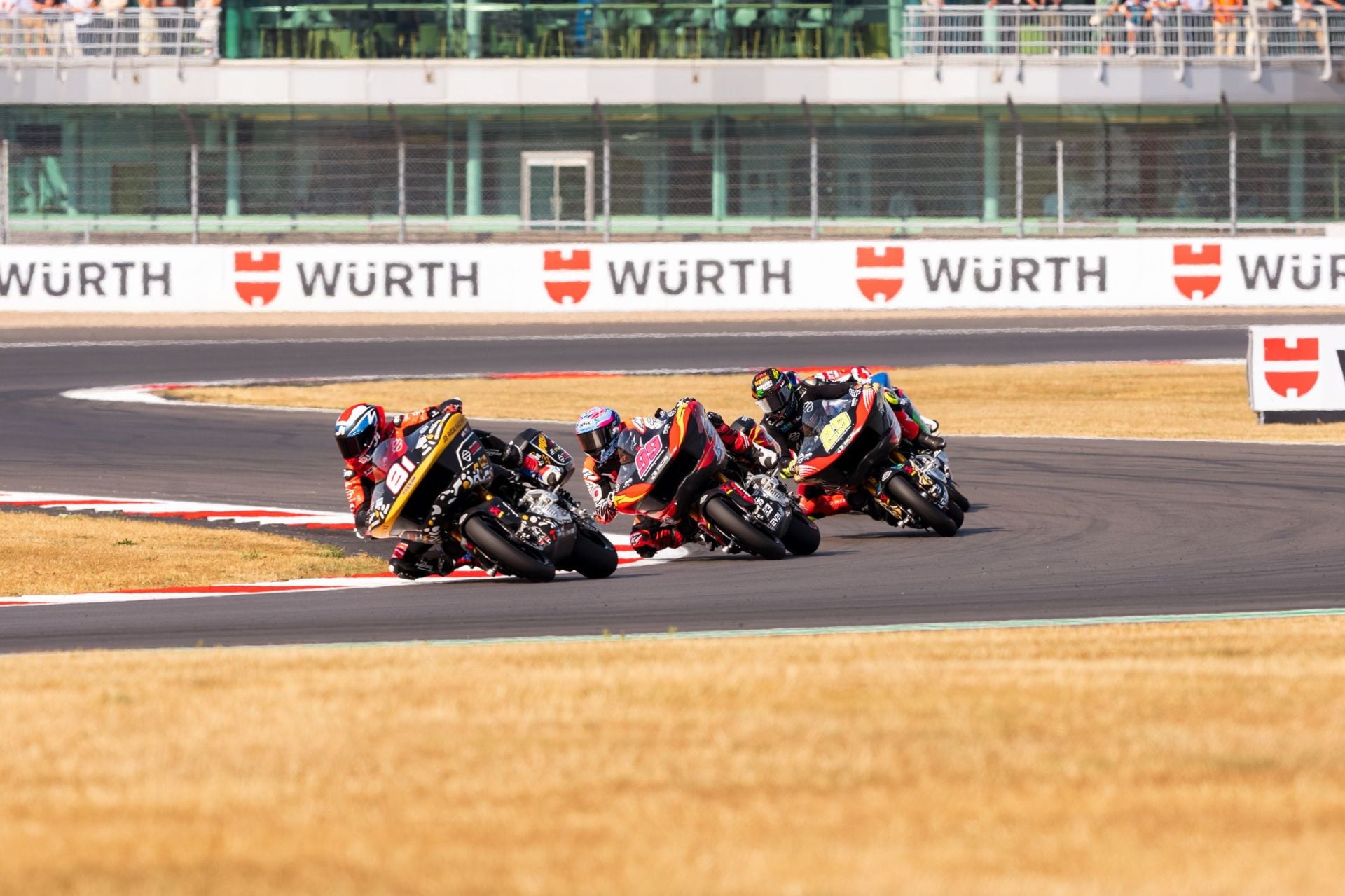
If you watched this weekend from the States and felt that competitive fire light up in your chest, good. That's the point. The Bagger World Cup is the clearest proof yet that the touring-class machines most of us ride to work, to rallies and across state lines are legitimate weapons on a purpose-built road circuit — and the mods that separate the podium finishers from the pack are the same mods available to you right now.
What Happened in Race 2
McDonald, who had already earned pole position for the Silverstone weekend, converted that front-row starting spot into a race win in convincing fashion. Running on Dunlop control tires — meaning every rider on the grid is working with the same rubber — McDonald and his Joe Rascal Racing crew built their advantage through chassis setup, power delivery and race craft rather than tire lottery. When the gap at the line is 0.757 second over seven laps, that margin comes from every other variable being dialed in tighter than the competition.
Teammate Eric Granado, who had been the fastest man on track in both free practice sessions earlier in the weekend, settled for second. Granado's pace throughout the Silverstone event was relentless — quickest in FP1, quickest in FP2 — which makes his runner-up result in Race 2 a testament to just how much McDonald raised his level when the points were on the line. Jordi Torres rounded out the podium in third, completing a Joe Rascal Racing 1-2-3 that should serve as a masterclass in how a well-organized bagger racing team operates.
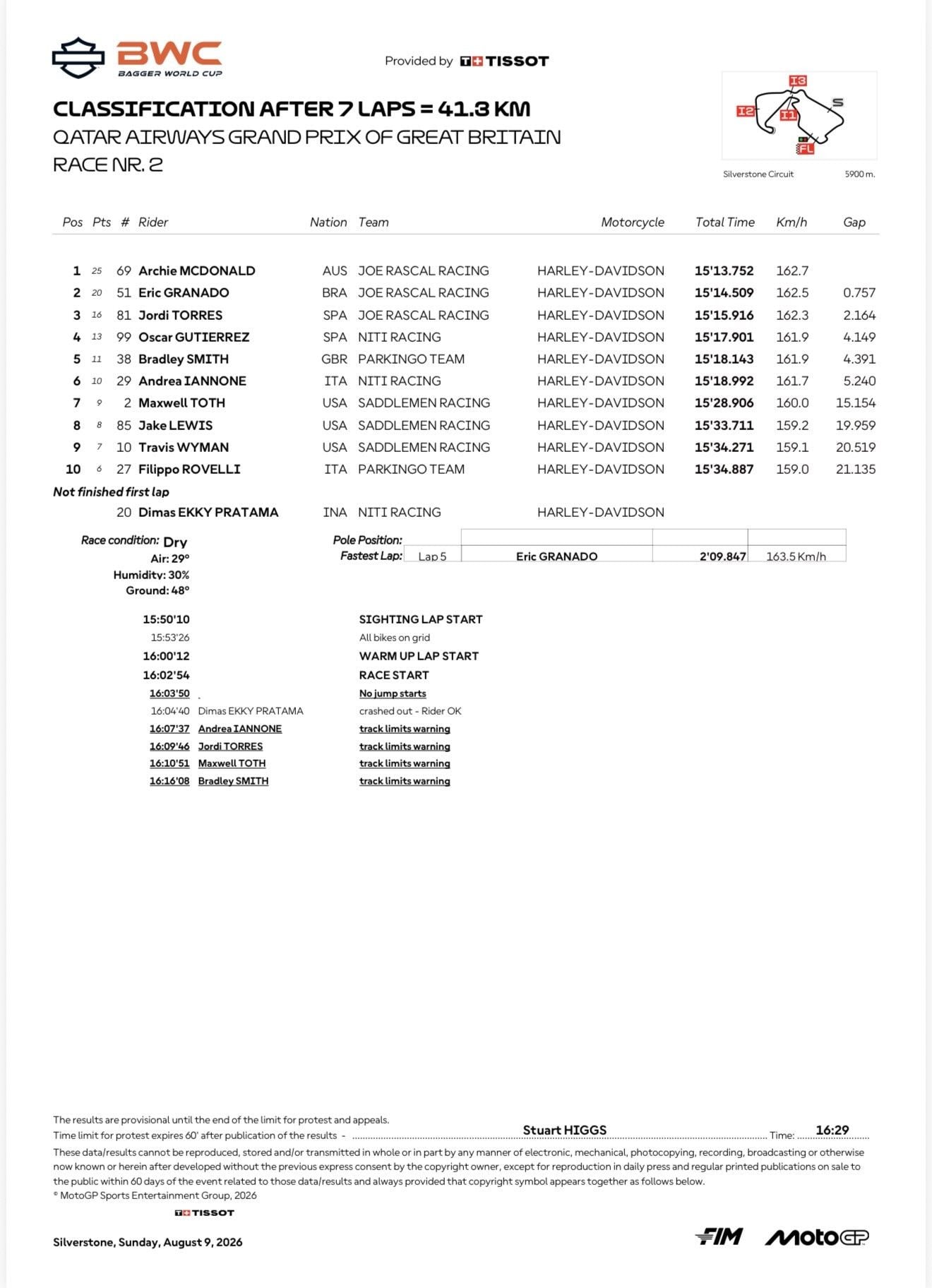
The American contingent on the Saddlemen Racing Harley-Davidson squad — Max Toth, Jake Lewis and Travis Wyman — finished seventh, eighth and ninth respectively. None of those results are ones the team will frame and hang on the wall, but racing at Silverstone against international competition at this level is a development exercise as much as anything else. The data those riders bring home from a circuit like this feeds directly into the setup decisions that will matter when the series heads somewhere more familiar.
The Weekend in Context: Race 1 Set the Stage
Before McDonald's Sunday win, the Silverstone weekend opened with a Race 1 victory for Bradley Smith — a home hero result that energized the British crowd on Saturday. Back-to-back days of bagger racing at one of the world's most storied circuits is a strong argument for how far the FIM Harley-Davidson Bagger World Cup has grown as a series. The combination of accessible machinery (these are production-based touring bikes, not exotic prototypes) and genuinely competitive racing is exactly what the series was built on.
For anyone building a performance bagger stateside with an eye toward what works at the top level, pay attention to the details: control tires mean the power and suspension setup are doing the heavy lifting. That's a direct signal about where to invest your build budget.
What Race-Level Bagger Builds Actually Require
The machines competing in the Bagger World Cup are Harley-Davidson touring bikes — Road Glides and Street Glides built on the Milwaukee Eight platform — developed under a set of regulations that keep the playing field competitive. What separates a race-winning bagger from one that's just loud and fast in a straight line is the complete package: power, suspension, brakes and the ability to carry speed through corners lap after lap without the chassis giving up.
Power That Doesn't Quit
On the street, most Milwaukee Eight 114 or 117 owners are leaving horsepower on the table. The stock engine management is tuned conservatively from the factory, and the performance air cleaner and exhaust restrictions compound that. A high-flow performance exhaust system paired with a proper tune is the most impactful first move you can make on any touring bike. Flow the exhaust, feed the engine clean air and remap the fuel delivery to match — that combination will transform how your Road Glide or Street Glide pulls from idle all the way through the top end.
For riders ready to go further, a Milwaukee Eight camshaft upgrade unlocks the engine's real personality. Cams dictate when the valves open and close, which controls the torque curve and peak power characteristics of the engine. Race teams running at events like Silverstone are not leaving their cam timing stock — and neither should you if you want your bagger to perform at its ceiling.
Suspension That Works the Circuit
Bagger suspension from the factory is a compromise. It works adequately for two-up highway riding, but when you start pressing a Road Glide through corners — whether on a track or on a canyon road — the stock setup runs out of capability fast. The front forks are under-sprung and under-damped for performance riding, and the rear shock is outright soft by any performance standard.
A rear suspension upgrade designed for the weight and geometry of a touring bike changes the entire character of how the bike corners. Proper spring rate and damping adjustability let you set the bike up for your weight, your riding style and your road conditions. On the front, progressive fork springs paired with adjusted fluid weight are the minimum — a full cartridge emulator kit or upgraded internals go further if your build demands it.
Brakes
Heavy bikes need more stopping force than most riders realize until they're late into a corner and the stock brakes have already told you no. This is true on a closed circuit and it's true on the street. Upgraded performance brake pads are the simplest, highest-value brake upgrade on any touring Harley. They run cooler, bite earlier and last longer under repeated hard use than OEM compounds. If your riding involves any mountain roads, track days or spirited canyon sessions, this is not optional.
Tuning: The Part Most Riders Skip
You can bolt on the best exhaust, the best air cleaner and a fresh cam and still be leaving performance on the floor if your fuel mapping doesn't match the hardware. Every power modification you make changes the engine's fueling requirements — more air and flow means the engine needs more fuel to match. An aftermarket fuel management system lets you (or a qualified dyno tuner) dial in the air-fuel ratio precisely across the entire RPM range. Dyno tuning your bagger after every major modification is not optional if you want the bike to run clean, pull hard and not torch itself over time.
Why the Bagger World Cup Matters to Your Build
Road racing with baggers used to be a novelty. American Flat Track brought the format to mainstream attention stateside, King of the Baggers at MotoAmerica gave it a professional series structure, and now the FIM Harley-Davidson Bagger World Cup is running at circuits like Silverstone — in front of MotoGP-weekend crowds — and producing genuine wheel-to-wheel racing with international fields.
Every lap those bikes turn at race speed validates the platform. The Milwaukee Eight touring chassis, when properly sorted, can handle the demands of road racing. The same suspension geometry, the same engine architecture, the same brake hardware that your Road Glide or Street Glide runs from the factory is the foundation that race teams build from. That's not a marketing line — it's what makes this class of racing meaningful to people who actually own and ride these machines.
McDonald's 0.757-second win at Silverstone didn't come from a completely different bike. It came from a better-prepared version of the same bike you might be riding to work tomorrow morning.
American Riders and the Road Ahead
For Toth, Lewis and Wyman on the Saddlemen Racing squad, seventh through ninth at Silverstone is a result that stings, but this program is still young in international terms. Racing at a circuit like Silverstone — with its high-speed sweepers, technical infield sections and notoriously unpredictable British weather — against a Joe Rascal Racing team that just swept the podium is a proving ground that will accelerate the development of every American bagger racer who makes the trip.
The fact that American riders and an American brand are competing at this level in England, on Dunlop control tires, against European competition, is the story itself. The series is real. The racing is real. And the performance parts that support these builds are available to every one of us.
Build Your Bagger Like It Belongs on Track
McDonald's Race 2 win at Silverstone is a reminder that the performance bagger platform has arrived on the world stage — and your build should reflect that ambition. Whether you're chasing a cleaner pull on the highway, looking to carve canyons with confidence, or thinking about a dedicated track day setup on your touring bike, the hardware that wins races is the hardware that transforms your street machine.
Start with the fundamentals: bolt on a performance exhaust that actually flows, add a high-flow air cleaner to feed the engine properly, and get your tune dialed in on the dyno. From there, address your suspension — a quality rear shock upgrade will do more for your corner confidence than almost any other single modification. And keep your brakes sharp with upgraded brake pads that can handle real heat. Shop our performance exhaust collection and suspension upgrades at vtwinbikers.com and build the bagger that belongs in the same conversation as the machines turning laps at Silverstone.