

Bradley Smith clocked the fastest lap in MotoAmerica Mission King of the Baggers warmup at Circuit of The Americas on Sunday, September 13, 2026, and the top-five order behind him tells you everything about where the bagger wars stand heading into race day. If you've been watching King of the Baggers and wondering what separates the front row from the rest of the field, the COTA warmup session is a masterclass in how factory-level setup trickles down to the parts you can bolt onto YOUR Road Glide or Street Glide right now.
Performance exhaust systems and precision tuning have defined this series from the start, and the gap between P1 and P5 at a technical circuit like COTA proves that every component on a racing bagger has to earn its place.
Smith on Top: The Harley-Davidson x Dynojet Factory Racing Machine
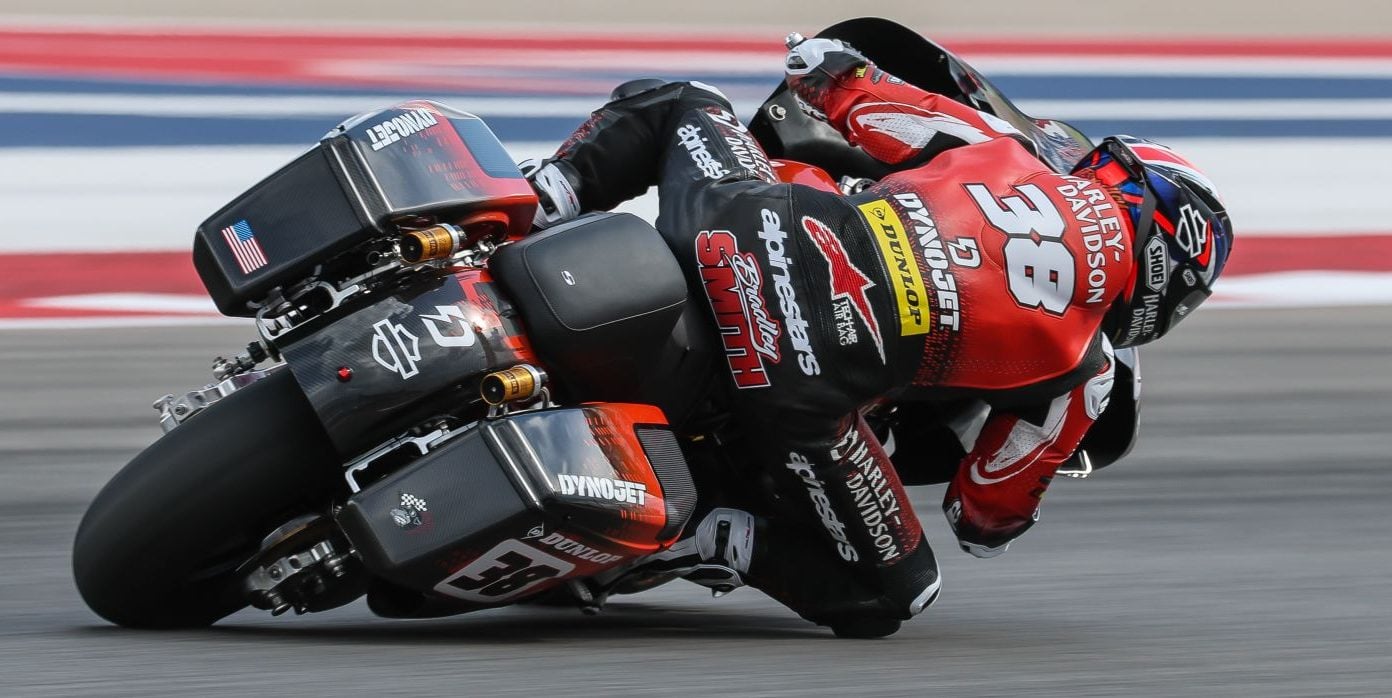
Bradley Smith turned in the quickest lap of the warmup session for Harley-Davidson x Dynojet Factory Racing, validating a setup that has clearly been dialed in for COTA's sweeping, high-speed corners and technical infield sections. COTA is no joke — it's a full MotoGP-grade circuit with elevation changes, long straights that reward top-end power, and tight infield chicanes that demand stable, responsive chassis behavior from a machine that weighs significantly more than a conventional road racer.
For a touring bagger to put in a competitive lap at a circuit like that, the power plant has to be tuned to perfection. Dynojet's involvement in this effort is a direct indicator of how critical fuel management and tuning hardware has become at the highest level of bagger racing. Smith's lap isn't just a number — it's proof that the combination of engine output, chassis work and software-level tuning is what separates the front of the grid from the pack.
Gillim and Herfoss Hold It Down for Indian
Hayden Gillim slotted into second for J&P Cycles/Motul/Vance & Hines Factory Indian, with teammate Troy Herfoss right behind him in third. The Indian Challenger platform has been a consistent threat throughout the King of the Baggers era, and a one-two punch from the factory Indian effort in warmup means the Harley camp cannot afford a single setup mistake before the green flag drops.
The Vance & Hines connection on the Indian side is worth noting. V&H has been developing exhaust solutions for racing baggers since before King of the Baggers had a formal championship structure, and their systems are proven at this level. On the street side, if you're building a performance bagger and you're not evaluating a Vance & Hines exhaust for your M8 or Indian platform, you're leaving power on the table. The flow characteristics developed for racing directly influence what you can achieve on a dyno-tuned street bike.
Wyman and Rispoli Round Out the Top Five
Kyle Wyman slotted in fourth for Harley-Davidson x Dynojet Factory Racing, giving the team a pair of riders in the top five. James Rispoli rounded out the top five for Big Diehl x Harley-Davidson Factory Racing. Three Harleys in the top five alongside two Indians is as tight a factory split as you're going to see, and it sets up a race-day battle that could go either way based on tire strategy and how each machine handles fuel load changes over a full race distance.
At COTA specifically, the combination of long-duration corner loading and high-speed straightaway pulls puts serious demand on suspension. The factory teams run bespoke setups, but the performance suspension technology they're leaning on — progressively valved forks, fully adjustable rear shocks — has direct equivalents in the aftermarket. Running performance bagger shocks on YOUR bike is the single biggest chassis upgrade most riders overlook. Weight transfer on a heavy touring platform during hard braking into COTA's Turn 11 is violent, and only properly valved suspension keeps that manageable.
What COTA Demands From a Bagger Platform
Circuit of The Americas was designed to challenge MotoGP machinery — the fact that King of the Baggers runs there at all is a statement about how far the platform has evolved. The circuit's 20 turns include a massive uphill section out of Turn One, a fast sweeping left at Turn Nine that loads rear tires hard, and the infield complex that demands short, precise braking and aggressive turn-in. For a bagger, all of that translates directly into setup priorities.
Engine output and power delivery — COTA's back straight is long enough that you need peak horsepower to compete. Factory teams are extracting serious output from their Milwaukee Eight and Indian PowerPlus engines through a combination of camshaft upgrades, head work and forced induction. On the street side, a performance camshaft upgrade for your Milwaukee Eight is the most cost-effective route to gains in that power band — cams change the engine's character at mid and top range without requiring you to tear the motor down completely.
Airflow and induction — Every horsepower you're leaving on the table through a restrictive air intake is a horsepower that doesn't exist at 120 mph on a back straight. A high-flow performance air cleaner paired with a proper exhaust and fuel tune is the foundational performance triangle for any bagger build. The factory teams optimized all three. YOUR build should do the same.
Braking hardware — COTA has multiple hard braking zones. The factory machines run upgraded rotors and radially mounted calipers that the stock touring platform simply cannot match. Upgraded brake components are not a cosmetic choice — at speed, they are a safety and performance necessity. If you're riding YOUR bagger at any pace beyond a casual cruise, your braking system should match your power output.
King of the Baggers Tech That Lives in the Aftermarket
The most important thing about King of the Baggers as a racing series is that it is explicitly NOT a spec series for exotica. These machines are built on production-based platforms, which means the development pipeline between the racing teams and the aftermarket parts you can order right now is shorter than in almost any other form of motorcycle racing.
When Dynojet is the title partner for a factory Harley racing effort, that is not a branding exercise. It reflects the fact that their tuning hardware — Power Visions, Power Commanders, Wideband kits — is what the team trusts when they need to get calibration exactly right on a race weekend. A Dynojet Power Vision running a custom race-calibrated map is how you turn a bolt-on exhaust and cam upgrade into a cohesive package that the engine management system actually recognizes and rewards with proper fueling across the full RPM range. Without that closed-loop software layer, you're leaving gains unrealized.
Similarly, the exhaust development that goes into a V&H race system has measurable carryover into their street products. Scavenging, back pressure tuning and header diameter choices that are race-validated at COTA translate into dyno numbers your tuner can work with on a street bike. It's not marketing — it's metallurgy and fluid dynamics that don't care whether the bike is on a closed circuit or an open highway.
Reading the Warmup: What to Watch in the Race
Warmup results are not qualifying. They are a final systems check — tire temps, suspension baseline, fueling at race weight. The fact that Smith was quickest tells you the Harley-Dynojet package came into Sunday morning already dialed in. They didn't need to hunt for time in warmup; they confirmed what they already knew.
Gillim and Herfoss running P2 and P3 means the Indian side is equally confident in their setup. When both factory camps come into race day with clean warmup sessions and no obvious setup scrambling, the race itself comes down to rider calls — when to push, when to manage tires, when to gamble on an overtake into a late braking zone.
For the Harley camp, having Wyman in fourth and Rispoli in fifth means there is team depth to apply pressure from behind. Rispoli under the Big Diehl x Harley banner running P5 in warmup suggests his machine is race-ready even if it's not yet at the pace of the very front. These are the dynamics that make the King of the Baggers grid genuinely competitive — not a two-horse race but a five-deep battle where the lead can change on a single turn.
Watch the starts. COTA's run to Turn One is long and wide enough that baggers can carry serious speed into the braking zone, which means the opening lap shuffle is aggressive. Whoever comes out of Turn One with momentum and clean air has a real advantage through the uphill section that follows.
Build YOUR Bagger for the Street the Same Way They Build for the Track
You're not running COTA on Sunday. But the engineering logic that makes Smith's machine the fastest bagger in warmup is identical to the engineering logic that makes YOUR Street Glide or Road Glide faster, more responsive and more satisfying to ride on every real road you actually ride.
Start with airflow. Get an aftermarket air cleaner on it so the engine can breathe. Run a proper performance exhaust that unlocks the gains from the intake side and drops weight in the process. Tune it — a proper dyno tune or a calibrated Dynojet fuel management solution is what turns those parts into a system instead of just a collection of bolt-ons. Add upgraded suspension so the chassis can actually use the power you've added. That is the same build logic the factory teams use — it scales from race track to highway without compromise.
Shop our performance exhaust collection and our tuner and fuel management lineup at vtwinbikers.com — everything you need to put the same race-proven thinking under YOUR bagger before the next race weekend gives you another excuse to finally pull the trigger.