

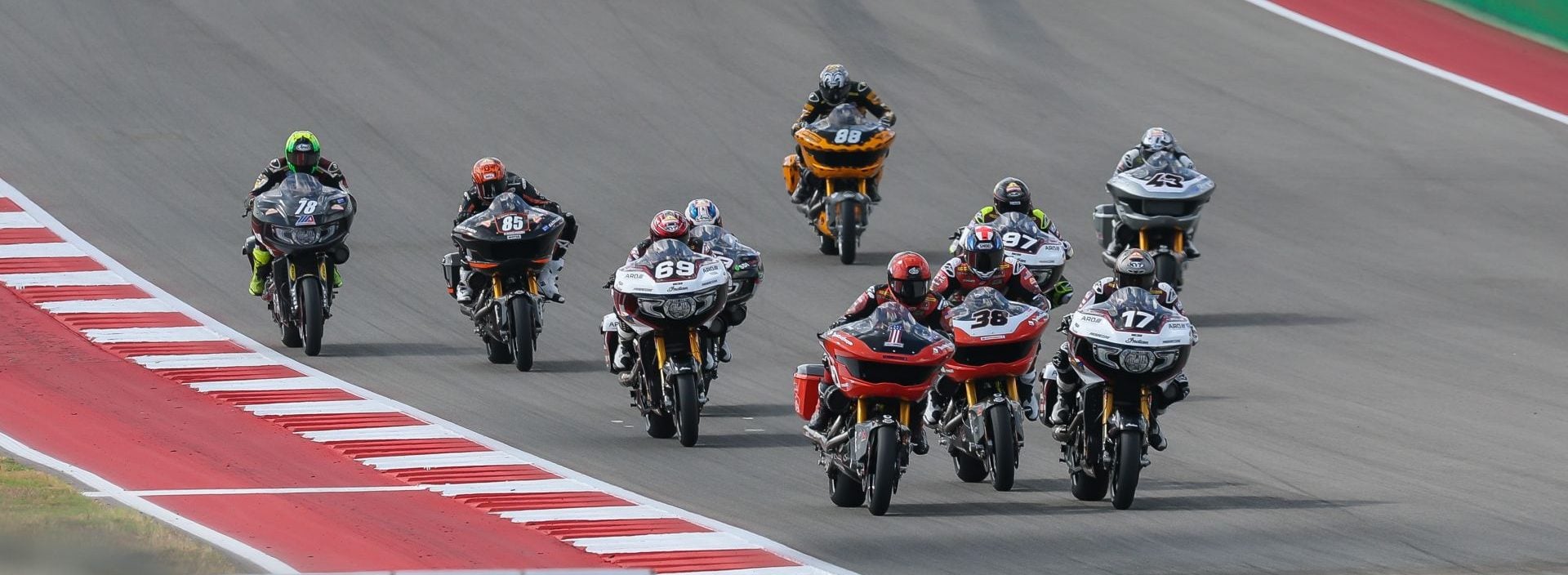
Bradley Smith put Harley-Davidson on top at Circuit of The Americas in MotoAmerica Mission King of the Baggers Race Two, edging out Hayden Gillim and Tyler O'Hara in a stacked Sunday result.
What COTA Demands From a Bagger
Circuit of The Americas is not a track that forgives compromise. Twenty turns, massive elevation changes through the back sector, and the long front straight that punishes any power deficit — it's a course built to expose exactly where a performance bagger is soft. High-speed sweepers like Turn 2 demand composure and steering geometry that doesn't fight the rider. The heavy braking zones into Turns 11 and 12 put suspension and brake setups under maximum stress. If your touring rig isn't dialed from wheel to wheel, COTA will find the weak link before lap one is done.
That's why what the King of the Baggers grid threw down here on Sunday is worth paying attention to. These aren't stock motorcycles rolling off a dealer floor. They're purpose-built race machines that started life as Milwaukee Eight-powered touring bikes and got transformed into something that can actually keep pace at a world-class circuit. The work that goes into that transformation — the tuning, the suspension, the exhaust, the airflow — is the same kind of work any serious rider should be thinking about for their own build.
Race Two Results: Smith Takes the Win
Harley-Davidson x Dynojet Factory Racing's Bradley Smith crossed the line first in Race Two on Sunday at COTA, handing the Milwaukee brand back-to-back momentum at a track that has been fiercely contested all season. J&P Cycles/Motul/Vance & Hines Factory Indian's Hayden Gillim gave chase and came home second, continuing to remind everyone that the Indian Challenger platform is a legitimate weapon in this series.
SDI Racing's Tyler O'Hara rounded out the podium in third — a result that keeps the SDI outfit in the conversation as the season pushes toward its closing rounds. Fourth went to Big Diehl x Harley-Davidson Factory Racing's James Rispoli, and rounding out the top five was Gillim's Vance & Hines teammate Troy Herfoss in fifth.
Five riders, two manufacturers, three teams — all separated by the kind of margins that remind you how compressed the King of the Baggers field has become. When Rispoli, a former KotB race winner, is coming home fourth and that's considered a solid but not spectacular day, the competition level at the front of this paddock has genuinely elevated.
What the Factory Builds Tell You About Your Own Bike
Here's the thing about watching King of the Baggers racing — every modification you see on those factory bikes maps directly to something you can do with your own Road Glide or Street Glide. The race teams aren't working with alien technology. They're working with the same fundamental Milwaukee Eight platform you ride, and they've pressure-tested which upgrades actually move the needle.
Exhaust: The First Real Gain
Vance & Hines is a name you saw in the results above for a reason. They've been in the King of the Baggers paddock since the beginning, and their exhaust development for Milwaukee Eight and Indian Challenger platforms is race-proven, not marketing copy. On your street build, a full exhaust system unlocks backpressure that the stock headers choke. The gains in mid-range torque — exactly the powerband range you actually use rolling out of a corner — are real and measurable on a dyno. Start with a performance exhaust system and you'll hear and feel the difference before you ever strap the bike to a dyno.
Air and Fuel: You Can't Outrun a Choked Intake
More flow out the back means you need more flow coming in the front. A high-flow performance air cleaner is the natural complement to any exhaust upgrade, and it's not a minor gain — factory air boxes on touring bikes are designed around emissions and noise compliance, not maximum power. Once you've opened the airflow both directions, the engine is going to want more fuel. That's where tuning becomes non-negotiable.
Tuning: The Step Most Riders Skip
Dynojet is literally in Bradley Smith's team name. That's not a coincidence. Race teams don't slap an exhaust on and call it done — they tune. A fuel management tuner lets you dial in air/fuel ratios to match your specific combination of parts. Running lean after an exhaust and intake swap isn't just leaving power on the table — it's running engine temperatures higher than they should be and creating reliability problems. Get the tune right and the whole package performs as a system, not a collection of parts fighting each other.
Suspension: The Part COTA Exposed
COTA's elevation changes and the violent transitions between corners put suspension in a position where mediocre setups get found out immediately. Watch the King of the Baggers footage from Turn 1 and the esses and you'll see bikes that are planted, not wallowing. That's not the stock suspension experience for most touring riders.
Factory race bikes run fully adjustable setups front and rear. For your street build, the upgrade path is straightforward: start with the rear, because a collapsed or blown stock rear shock on a heavy touring bike is one of the most common performance killers there is. An upgraded performance rear shock transforms the handling feel of a Road Glide or Street Glide immediately — it's a before-and-after upgrade that doesn't require a single dyno pull to validate.
Front end work matters too. Cartridge emulators or a full front fork upgrade kit bring the front end compliance up to match a better rear, and give you the feedback through the bars that actually lets you ride with confidence on technical roads. Mismatched suspension — good rear, stock front, or vice versa — is a handling problem that no amount of tire pressure adjusting will fix.
Brakes, Tires and the Foundation Pieces
Dunlop is the official tire of the MotoAmerica Series, and Sportmax Slicks are what the King of the Baggers grid runs. For your street build you're running street rubber, but the principle the race teams apply holds: contact patch quality matters. Tire choice is a performance decision, not just a wear decision.
Brakes on the race bikes are far beyond stock — larger rotors, radial calipers, braided lines. For your build, brake upgrades including braided stainless lines are one of the most cost-efficient safety and performance modifications you can make. Stock rubber brake lines expand slightly under pressure, adding sponginess to the lever feel. Braided lines are firm, consistent and transmit actual feedback. At COTA-style braking zones — even on a canyon road — that feedback matters.
The Cam and Engine Build Conversation
If you want to follow the factory race teams deeper into the engine, the camshaft is the next serious conversation. A performance Milwaukee Eight camshaft changes the entire character of the engine — when power comes on, how it breathes at high rpm, where the torque peak lives. The stock Milwaukee Eight 114 is a 1,868cc motor that makes respectable power in factory form, but the cam profiles H-D chose are a compromise between emissions, noise, fuel economy and power. A racing or street-performance cam lifts that compromise and lets the engine breathe the way the displacement should allow.
Cam upgrades require attention to supporting work — pushrods, lifters, potentially valve springs depending on the cam spec — so this is a build conversation, not a drop-in, but the payoff is a fundamentally more alive engine that rewards every other modification you've already made.
What the COTA Round Means for the 2026 Season
Smith's win keeps Harley-Davidson's factory effort in the thick of the championship picture heading into the remaining rounds. Gillim's second place shows the Indian Challenger team isn't conceding anything — Vance & Hines and J&P Cycles have invested heavily in that program and it shows in the results.
O'Hara's podium in third is a reminder that SDI Racing punches at the factory team level consistently. Rispoli in fourth continues to demonstrate that the Big Diehl Harley entry is a front-of-field threat every round, not a one-race flash. And Herfoss rounding out the top five in his debut KotB season tells you the talent pool coming into this series is getting deeper.
The King of the Baggers class has matured into a legitimate professional road racing series, and what it's doing for the performance bagger parts market is tangible. Every race teaches teams — and by extension, the aftermarket — what works under real competition load. That information filters down into the parts you can buy and put on your own bike.
That's the real reason to watch. Not just the racing itself, but what the racing proves.
Build Your Own Race-Informed Bagger
Bradley Smith didn't win at COTA on a stock Harley-Davidson, and Hayden Gillim didn't chase him to second on a showroom Indian. Every part on those bikes was chosen because it made the machine faster, more planted and more reliable under race conditions. The same logic applies to your build. Start with your performance exhaust to unlock the power your engine is already trying to make, layer in a properly matched high-flow air cleaner and fuel tune, then work through suspension and brakes as your build evolves. Shop our performance exhaust collection and bagger suspension upgrades at vtwinbikers.com and start building the bike that actually matches what you know a Milwaukee Eight can do.