

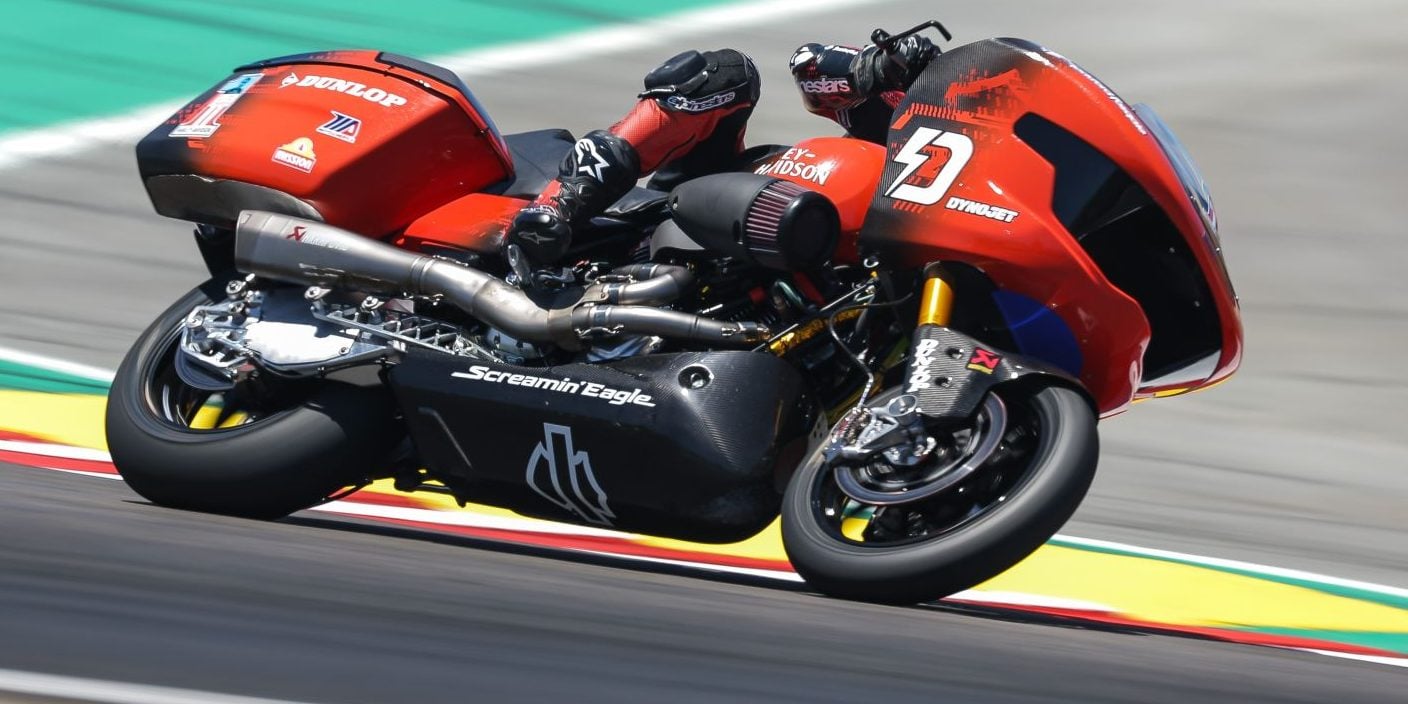
Kyle Wyman put the Harley-Davidson x Dynojet Factory Racing machine at the top of the timing sheets in Sunday's MotoAmerica Mission King of the Baggers warmup session at WeatherTech Raceway Laguna Seca. If you've been watching the KOTB series this season and wondering what separates the front runners from the field, the answer is always the same: factory-level preparation layered on top of purpose-built components that the rest of us can actually study, source and learn from.
The Warmup Sheet: What the Times Tell You
Warmup sessions don't hand out trophies, but they tell you everything about where a team's setup is relative to the rest of the grid. Wyman going fastest ahead of J&P Cycles/Motul/Vance & Hines Factory Indian's Troy Herfoss and Hayden Gillim means the Harley-Davidson program walked into race day with real momentum — not just the confidence of a warm engine, but a dialed-in chassis speaking the language of Laguna Seca's elevation changes and signature Corkscrew.
The full warmup order told the story of a tightly contested field:
1. Kyle Wyman — Harley-Davidson x Dynojet Factory Racing
2. Troy Herfoss — J&P Cycles/Motul/Vance & Hines Factory Indian
3. Hayden Gillim — J&P Cycles/Motul/Vance & Hines Factory Indian
4. Bradley Smith — Harley-Davidson x Dynojet Factory Racing
5. Rocco Landers — J&P Cycles/Motul/Vance & Hines Factory Indian
Two factory programs. Five riders within reach of each other. The margin between first and fifth in a KOTB warmup at a technical circuit like Laguna is razor-thin, and that kind of parity tells you the series is healthy — and that the baseline hardware these teams are refining is genuinely capable.
Why Laguna Seca Punishes the Unprepared
WeatherTech Raceway Laguna Seca is not a forgiving venue for a touring bike. At 2.238 miles with 11 turns and a total elevation change of 180 feet, it demands suspension precision that most factory baggers don't have straight off the showroom floor. The Corkscrew — the blind left-right flick dropping nearly 60 feet over two corners — exposes any softness in your front end and any instability in your rear suspension immediately.
For factory teams, that means fully adjustable, race-specification suspension at both ends. For builders and riders following this series for inspiration, it's a direct argument for upgrading your bagger rear shocks and front suspension well before you approach any kind of spirited canyon or track riding. What the factories run is the ceiling — what we can put on our own builds are production versions of the same engineering philosophy.
The front end geometry matters just as much. Wyman's Harley being able to carry corner speed through sections like Turn 2 and the downhill entry at Turn 5 isn't luck — it's the result of months of chassis data, combined with an exhaust and engine tune that delivers tractable, predictable power rather than sharp spikes that upset the chassis mid-corner.
The Engine Package Behind a KOTB Front Runner
Harley-Davidson's factory KOTB entry runs a Milwaukee Eight-based powerplant that's been built to the limits of the class ruleset. The Milwaukee Eight 117 — a 1923cc V-twin — forms the displacement foundation for the top Harley touring builds, and in factory race trim that architecture is pushed as hard as the regulations allow.
What does that mean in practice? It starts with camshaft selection. Race-oriented Milwaukee Eight cams reshape the torque curve to favor mid-range pull through a racetrack's acceleration zones, moving peak power higher without sacrificing the broad-shouldered grunt that makes baggers distinct from supersport machines. You're not trying to build a sportbike — you're building something that pulls like a freight train from 3,500 RPM through redline.
The induction side is equally critical. High-flow performance air cleaners let the engine breathe at the volume a built motor demands. Restrict the intake and you strangle everything the cam and cylinder work created upstream. Factory teams run induction systems that are optimized for maximum airflow at race RPM — the same principle applies when you're building your own Milwaukee Eight for performance street use.
Then there's the exhaust. The Vance & Hines factory Indian program is named after one of the most respected exhaust manufacturers in the V-twin world for a reason. Header diameter, collector design and muffler flow all affect backpressure, scavenging efficiency and ultimately where your power lands in the RPM range. A proper performance exhaust system isn't a cosmetic upgrade — it's a tuning variable as significant as your cam choice.
Dynojet's Role in the Harley Factory Program
The fact that Harley-Davidson's factory KOTB effort carries Dynojet's name in its team title isn't a coincidence or a simple sponsorship arrangement. Dynojet has been the dominant force in motorcycle fuel and ignition management for decades, and their PowerVision and Power Commander platforms are what most serious V-twin builders use to translate hardware changes into actual dyno gains.
You can bolt on every performance component available, but without a proper tune to recalibrate fueling and ignition timing to match your new cam profile, exhaust and air cleaner, you're leaving power on the table — and potentially running a dangerously lean air-fuel ratio. A Dynojet fuel tuner running a custom map built on a dyno with your specific combination of parts is how you turn a list of components into a coherent, reliable performance package.
For the Wyman machine, every warmup and practice lap generates data that feeds back into the tune. The closed-loop between on-track performance and calibration is exactly the kind of iterative process that separates a fast bike from a winning one. That same feedback loop is available to any builder willing to invest in a quality tuner and a few hours on a reputable dyno.
Bradley Smith and the Depth of the Harley Program
Fourth place for Bradley Smith in the warmup is worth noting. Having two bikes from the same factory program in the top four — Wyman first, Smith fourth — demonstrates that the Harley-Davidson x Dynojet setup isn't a one-bike phenomenon built around a single rider's preference. The setup translates across riders, which points toward a fundamentally sound chassis and engine package rather than one rider extracting something unusual from a finicky build.
Smith's presence in this program also brings road racing experience from the highest levels of the sport internationally. That kind of rider background paired with a well-developed American V-twin touring platform is exactly the combination that elevates the technical conversation around what baggers can do at a World Superbike-caliber facility like Laguna Seca.
What Race Day Setup Looks Like for a KOTB Competitor
The warmup session is the last chance to validate setup changes made after qualifying. Teams will adjust suspension preload and damping based on how the track surface has evolved, tire pressures are dialed to account for Sunday ambient temperatures, and any fueling anomalies caught in practice get addressed in the tune. By the time the warmup sheet posts, the teams that ran smoothly have effectively confirmed their race-day configuration.
For the privateers and semi-factory entries further down the grid, warmup is often the only remaining opportunity to find time. A performance bagger suspension upgrade that wasn't quite right in qualifying might get a compression damping adjustment that suddenly unlocks a half-second per lap. That's the granular, obsessive level of preparation that defines competitive KOTB racing.
Breaking pads are another variable that teams manage carefully across a race weekend. Laguna Seca's hard braking zones — particularly the Turn 2 entry off the front straight and the Turn 11 hairpin — load front brake systems hard, repeatedly. Factory teams run purpose-built race compounds matched to their caliper and rotor specifications. On your own build, performance brake pads matched to your specific usage — street, canyon, track day — represent one of the highest-value safety and performance upgrades you can make, and one of the most overlooked.
Why This Series Matters to Your Build
MotoAmerica Mission King of the Baggers is not a novelty class. It started as proof of concept — could production-based touring bikes actually race wheel-to-wheel at serious road racing venues? The answer has been a definitive yes, and the technical development that's followed has been real, fast and directly applicable to what performance bagger riders are building in shops across the country.
Every component category that defines a KOTB front runner — exhaust, cams, induction, fuel management, suspension — has a street-applicable counterpart. When Wyman goes fastest in warmup at Laguna Seca, he's not doing it on unobtainium hardware. He's doing it on refined, developed versions of the same performance parts ecosystem that you can build your touring bike around.
The Harley versus Indian battle that plays out every KOTB weekend is ultimately a competition between two highly developed V-twin touring platforms, each running performance components pushed to their engineering limits. The takeaway for your build isn't to pick a side — it's to understand that the performance ceiling for your Road Glide or Street Glide is dramatically higher than stock, and the path to getting there runs through the same categories these factory teams obsess over.
Ready to start building? Get your engine breathing and sounding right with a performance exhaust from our catalog, and lock in your tune with a Dynojet Power Commander or PowerVision built for your specific Milwaukee Eight combination. Shop our complete performance exhaust collection and fuel management lineup at vtwinbikers.com — because the warmup sheet rewards preparation, and preparation starts before you ever leave the shop.