

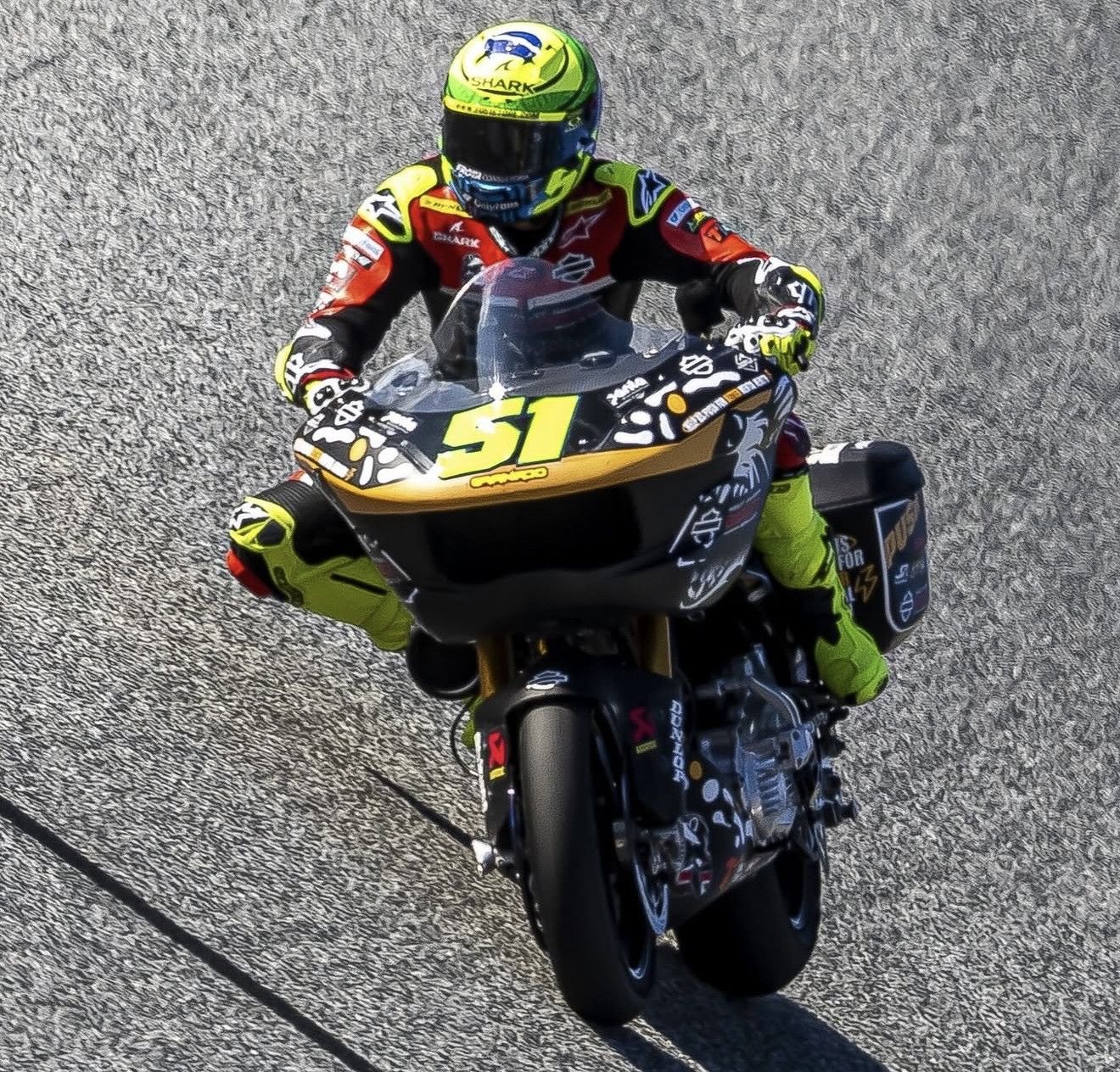
The fastest production-based touring bikes on the planet just ran qualifying at one of the most technical road courses in Europe, and a Brazilian on a Harley-Davidson topped them all. Eric Granado's pole lap at Red Bull Ring is a reminder of how far the performance bagger platform has come — and what's possible when you stop treating a touring bike like a couch and start treating it like a race machine. If you've been on the fence about upgrading your bagger, this weekend in Austria is your motivation.
Granado Goes Fastest: The Numbers That Matter
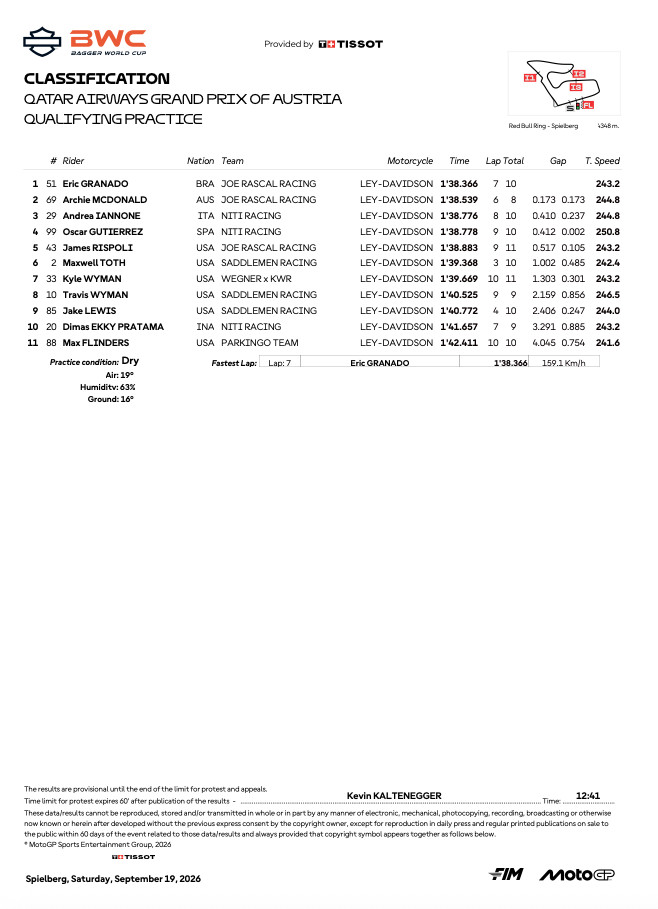
Saturday afternoon at Red Bull Ring — Spielberg, Austria — Eric Granado put his Joe Rascal Racing Harley-Davidson on Dunlop control tires and covered the 2.7-mile (4.35 km) road course in 1:38.366. That was good enough to top a field of 11 riders and secure pole position for the FIM Harley-Davidson Bagger World Cup round.
Let that distance sink in: 2.7 miles of Austrian tarmac, elevation changes, high-speed sweepers and hard braking zones, all on a platform that started life as a highway cruiser. The Red Bull Ring is not a flat, forgiving oval. It punishes soft suspension, lazy brakes and anything that can't put power down cleanly on corner exit. The fact that these bikes are competitive here at all says everything about how the platform has evolved.
Granado's teammate Archie McDonald slotted into second with a 1:38.539 — just 0.173 seconds back — confirming that Joe Rascal Racing has sorted their package heading into race day. Third went to Andrea Iannone on the Niti Racing Harley-Davidson with a 1:38.776, putting three different riders within less than half a second of each other at the sharp end of the grid.
The Americans: Rispoli, Wyman and the Saddlemen Squad
American representation at this round is strong. James Rispoli lined up fifth with a 1:38.883 on his Joe Rascal Racing Harley-Davidson — less than six tenths off pole and well inside the lead group. Kyle Wyman, reigning King of the Baggers champion racing as an independent wildcard with WEGNER X KWR Harley-Davidson, put himself seventh at 1:39.669.
The Saddlemen Racing Harley-Davidson squad brought three Americans: Max Toth went sixth (1:39.368), Travis Wyman eighth (1:40.525) and Jake Lewis ninth (1:40.772). Max Flinders rounded out the field in 11th on his ParkinGO TEAM Harley-Davidson at 1:42.411.
For context: the gap from pole to 11th in a field this size, on a circuit this demanding, is just over four seconds. That is an extraordinarily tight qualifying sheet. These bikes are not separated by radical differences in machinery — they are separated by setup, rider skill and the fine-detail execution of every performance variable on the bike.
What Race-Level Baggers Actually Run
Here is where the content of a Bagger World Cup qualifying session becomes directly relevant to what you bolt onto your own Road Glide or Street Glide. The race teams competing in this series are running production-based Harley-Davidson touring platforms, developed under regulations that keep them recognizable as the bikes you see in dealerships. The upgrades that separate a competitive Bagger World Cup machine from a stock Milwaukee Eight are the same categories of upgrades your build needs — just executed at a higher development budget.
Exhaust: Flow or Die
Every competitive bagger in this field is moving exhaust gases as efficiently as physics allows. There is no power you can't lose through a restrictive exhaust system, and no money better spent on a Milwaukee Eight than freeing up that exhaust flow. A full performance exhaust system is where horsepower gains start on the M8 platform — not because it sounds better (it will), but because the engine can breathe out as well as it breathes in.
Pair your exhaust work with a proper high-flow air cleaner and you have the foundation of every meaningful performance build, from street to race. The intake and exhaust work together. Opening one side of the equation without the other leaves power on the table.
Cams and Bottom-End Work
The Milwaukee Eight in stock trim is deliberately conservative on camshaft timing. The engine is built to be reliable across a broad rpm band for touring use, not to make peak power at race pace. A set of performance M8 performance cams changes the character of the engine entirely — more lift, more duration, more overlap, more power where you actually need it when you're pushing hard into a corner exit.
If you're building toward real performance territory, cam work is the single highest-leverage internal modification you can make short of a displacement change. The riders competing at Red Bull Ring are not winning on stock timing events.
Suspension: The Part Street Riders Ignore
Red Bull Ring has significant elevation changes and high-speed direction changes that destroy soft, undersprung suspension. Granado didn't get to pole position by running stock Harley shocks — and neither should your bagger if you're running it hard. Upgraded rear shocks and front suspension components are what keep a touring bike planted and predictable when you're pushing the limits of the platform.
This applies directly to your street miles. Stock Harley touring suspension is tuned for passenger comfort and highway compliance. If you want to corner with confidence, carry speed through curves or simply feel what the front wheel is doing on a twisty road, suspension is where the money goes after exhaust and cam work.
Brakes: Austrian Stopping Power
Red Bull Ring demands hard, late braking. The teams running competitive lap times are not stock-caliper operations. Upgraded brake systems — rotors, pads, lines, or full caliper upgrades — are part of what allows a bagger to be pushed at this pace on a road course. For street riders, brake upgrades are often the last thing on the list and should be among the first. Better braking means more confidence, later stops and the ability to carry more entry speed into corners.
Why Austria and Why This Season Matters
The FIM Harley-Davidson Bagger World Cup running at circuits like Red Bull Ring and MotorLand Aragon — tracks that host MotoGP — is a significant statement about the legitimacy of the bagger racing platform. This is not a flat-track or drag strip niche series. These are full road course events at internationally sanctioned venues, competing on the same weekends as the world's top motorcycle racing series.
Granado's pole position continues a strong season for the Brazilian rider, who was also fastest in Free Practice 2 in Austria according to related coverage from the same event weekend. McDonald's closest-to-pole effort in second shows Joe Rascal Racing came to Austria with their setup dialed. Andrea Iannone's third on the Niti Racing bike confirms the top of the field is genuinely competitive — no single team has this thing locked up heading into race day.
For the Americans in the field, Rispoli's fifth, the Wyman brothers and Toth representing Saddlemen Racing, and Kyle Wyman's wildcard entry mean there's genuine national pride on the line when the race starts. King of the Baggers and the Bagger World Cup are feeding off each other's development — teams and riders crossing between series, pushing the platform harder than anyone thought possible five years ago.
From Race Grid to Your Garage
The connection between a 1:38 lap at Red Bull Ring and your Road Glide sitting in the garage is more direct than you might think. The parts categories that separate a competitive race bagger from a stock machine are the same categories you should be working through on your own build — exhaust flow, cam timing, suspension compliance and braking performance. You do not need a race team budget to start moving in that direction.
Every upgrade you make to your touring bike's performance system brings it closer to what these machines do on a full road course. That means more confidence on canyon roads, more capability on a track day if you choose to pursue one and — most importantly — a machine that actually responds the way you want it to when you ask something of it.
The Bagger World Cup qualifying sheet from Austria shows what's possible when the platform is developed seriously. Granado's pole lap is the high-water mark. Your job is to close the gap between your bike and that benchmark, one part at a time.
Shop our Harley exhaust systems and bagger suspension upgrades at vtwinbikers.com and start building toward the performance these race results prove is possible on the Milwaukee Eight platform.