

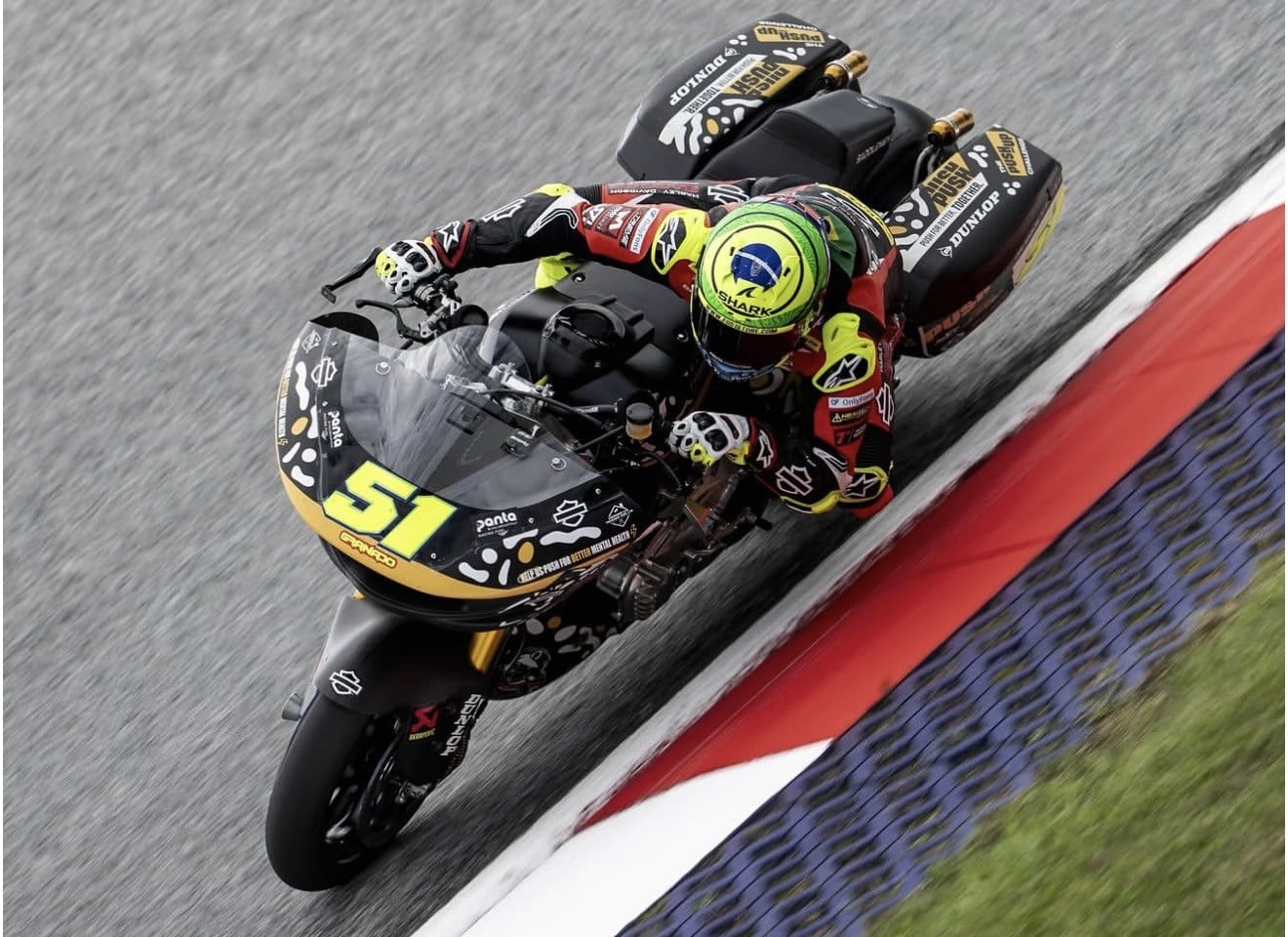
Eric Granado just put his Joe Rascal Racing Harley-Davidson on top of the FIM Harley-Davidson Bagger World Cup timing sheet in Friday afternoon's Free Practice 2 session at Red Bull Ring – Spielberg, Austria. If you've been watching the Bagger World Cup grow from a novelty into a legitimate international racing series, this session is proof the competition has arrived on the world stage — and the machinery doing it is closer to what you're riding than you might think.
Granado on Top: The FP2 Session Breakdown
Granado's fastest lap of 1:39.014 covered the 2.7-mile (4.35 km) Red Bull Ring circuit — one of MotoGP's premier venues — on Dunlop control tires, topping a field of 11 riders. That's a pace that would have been unthinkable on a full-dress touring bagger even five years ago. The Red Bull Ring is a high-speed, flowing circuit that rewards power and stability more than late braking finesse, which makes a strong result here a real indicator of where a team's engine package and chassis setup stand.
Oscar Gutierrez on the Niti Racing Harley-Davidson slotted into second at 1:39.424 — just 0.41 seconds off the pace. Granado's own teammate, Archie McDonald, rounded out the top three with a 1:39.490, meaning the Joe Rascal Racing squad sandwiched Gutierrez and occupied two of the three podium positions in FP2. That's a team showing real organizational depth.
For the American contingent, Kyle Wyman brought his WEGNER X KWR Harley-Davidson home seventh at 1:40.482, and James Rispoli — also running under the Joe Rascal Racing banner — finished eighth at 1:40.504. The Saddlemen Racing Harley-Davidson squad placed three riders in the session: Max Toth fifth (1:39.512), Travis Wyman sixth (1:40.334) and Jake Lewis tenth (1:41.952). Max Flinders on the ParkinGO TEAM Harley-Davidson got ninth with a 1:41.900.
What the Red Bull Ring Demands From a Bagger
The Red Bull Ring isn't a track that forgives a weak power-to-weight ratio or a chassis that wants to wallow. Its long straights — particularly the run from Turn 3 to Turn 4 and the final sector — put an enormous premium on top-end power and the ability to carry speed through fast, sweeping corners at full lean. For a Milwaukee-Eight-based touring machine, that means every component in the drivetrain has to be optimized.
At this level, teams are running heavily massaged engines — ported heads, aggressive cam profiles, high-compression pistons and purpose-built exhaust systems — all chasing the last few horsepower available within the rules. A performance cam upgrade is one of the first places power gains show up on a Milwaukee Eight, and what works on a race bike translates directly to what you can do on your street bagger. Lift, duration and lobe separation angle all determine where in the RPM range your torque curve peaks — on a track like Red Bull Ring, teams want that curve to stay broad and high.
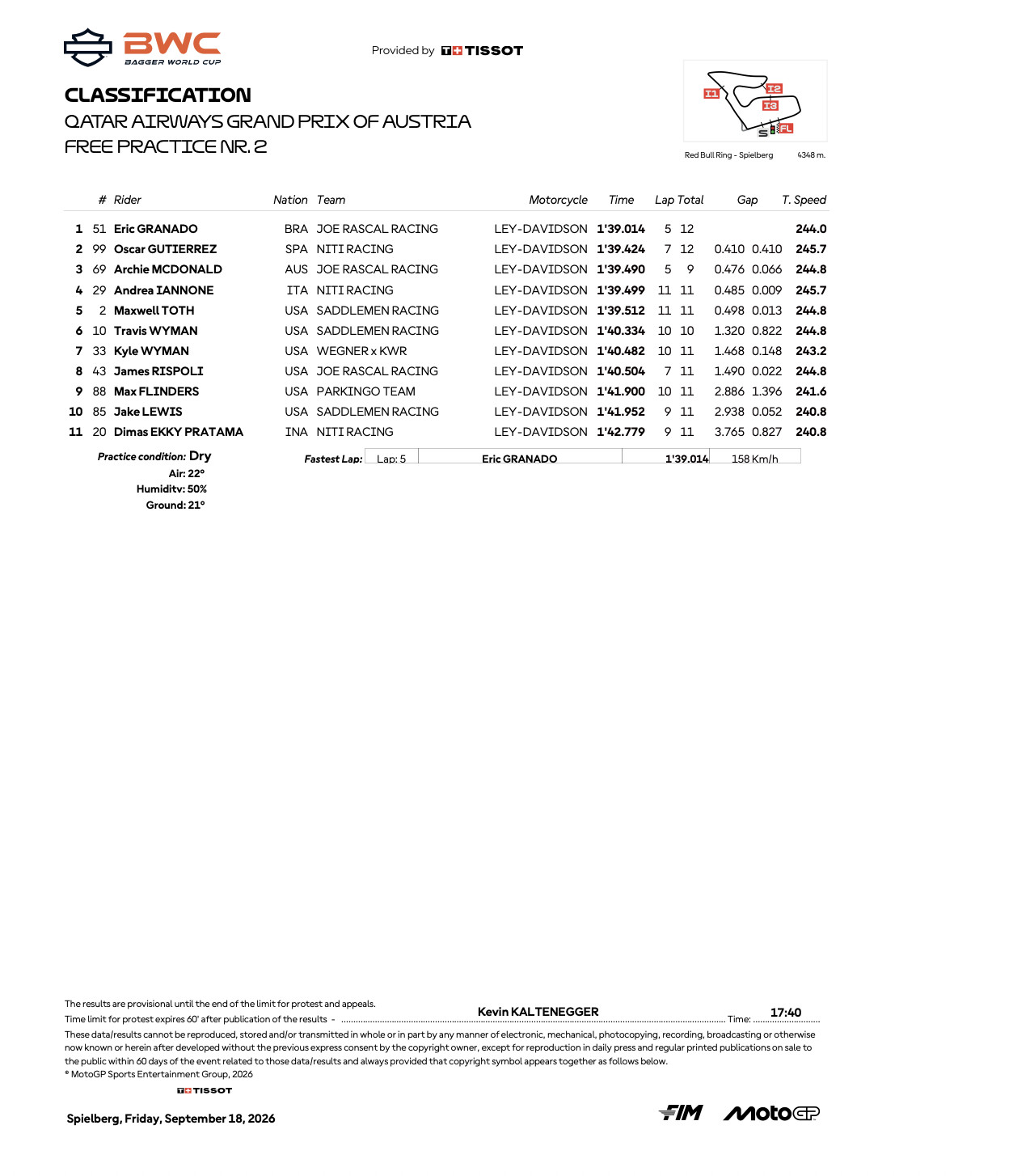
Control tires — Dunlops in this case — level the rubber playing field, which means any time gap you see in these results comes down to power, suspension tuning and rider skill. Nothing else. That's why the spread between Granado's 1:39.014 and Lewis's 1:41.952 — about three seconds across 11 riders — tells you something meaningful about chassis setup and engine development, not just who can find a hot tire.
The Bagger World Cup's Global Moment
Let's put this session in context. The FIM Harley-Davidson Bagger World Cup is running as a support series at a MotoGP event. The same weekend Pedro Acosta was leading the premier class, and Filip Salac was breaking Moto2 records at the same circuit, touring baggers were turning sub-1:40 laps. That is not a sentence anyone would have written a decade ago.
For American riders, seeing names like Kyle Wyman, James Rispoli, Max Toth, Travis Wyman and Jake Lewis competing on an international stage against a genuinely deep field is significant. These are riders who have proven themselves in King of the Baggers at MotoAmerica rounds domestically — now taking that same hardware to Europe and holding their own at a circuit that has hosted some of the greatest MotoGP battles in recent history.
The series runs on Dunlop control tires, which standardizes the rubber across the whole field. That makes the machine — and the people building it — the differentiating variable. It's a purist's format.
What Race-Proven Bagger Tech Means for YOUR Build
Here's where it gets relevant to what you're building in your garage or what you're asking your shop to spec out. The technology that separates the front of that grid from the back is not exotic or unobtainable — it's a disciplined, layered approach to modifications that compound on each other.
Exhaust flow is the foundation. On a Milwaukee Eight, the factory exhaust is a restriction. Teams running at the front are moving spent gas as fast as possible. A performance bagger exhaust on your touring bike does the same thing — lowers back pressure, allows the engine to breathe on the exhaust stroke, and complements whatever cam and intake work you've already done. Pairing an exhaust upgrade with a proper high-flow air cleaner gives the engine unrestricted airflow on both ends of the combustion cycle.
Suspension is what keeps the power on the ground. Red Bull Ring's elevation changes and fast corners punish a soft, wallowing chassis. Race teams run fully adjustable suspension front and rear — and you should be thinking the same way. Upgrading your rear shocks to a proper performance unit with adjustable preload and damping is one of the highest-impact modifications you can make to a touring bagger for both handling and high-speed stability.
Brakes are non-negotiable at speed. At the Red Bull Ring, riders are hauling down from triple-digit speeds into corners. Upgraded brake pads and rotors are what stand between carrying speed through a corner and running wide. On the street, the same principle applies — fade-resistant compound brake pads and properly bled lines give you confidence in your stopping power when it matters.
Tuning ties it all together. No combination of exhaust, air cleaner, cam and suspension upgrades performs to its potential without a proper tune. A fuel and ignition map calibrated for your specific modifications — ideally validated on a dyno — is what separates a bike that runs well from one that runs at its full potential. A quality fuel management tuner is the last piece that makes your hardware work as a system instead of a collection of individual parts.
The American Riders to Watch
Kyle Wyman's seventh-place result in FP2 with the WEGNER X KWR program is worth noting. The WEGNER name carries real credibility in the Milwaukee Eight performance world, and Wyman has been a consistent frontrunner in bagger racing domestically. Seventh on a circuit as demanding as Red Bull Ring, against a field that includes some seriously developed machinery, is a competitive result — not a consolation.
The Saddlemen Racing trio of Toth, Travis Wyman and Lewis occupying fifth, sixth and tenth shows that team depth matters in this format. Saddlemen has built a multi-rider effort that can collect points across the field, which is a different strategic posture than a two-rider attack program like Joe Rascal Racing. Both approaches have merit, and we'll see which translates better when qualifying and the race play out.
James Rispoli sitting eighth — one position behind his teammate Granado in first — shows the gap between the front and the rest of the Joe Rascal effort. Setup and rider confidence on an unfamiliar circuit in FP2 can account for a lot of that gap. FP1 saw Archie McDonald on top, FP2 went to Granado — this team is rotating pace between multiple riders, which suggests a well-developed package rather than a one-rider show.
Qualifying and Race Day: What to Expect
FP2 pace at Red Bull Ring historically translates well to qualifying and race pace — the circuit doesn't have a lot of variables that change dramatically across sessions. Granado's 1:39.014 puts him in the driver's seat for pole position, but a tenth-of-a-second gap to Gutierrez and McDonald means this is not a runaway situation. Qualifying will tighten those gaps as everyone runs stickers and chases a hot lap.
In the race itself, tire management on Dunlop control rubber will be the variable that rewrites the order from what practice times suggest. Red Bull Ring's abrasive surface and high-speed demands can heat tires aggressively, and a rider who can manage rear grip over race distance will have a meaningful advantage over someone who burns the tire trying to match early pace.
Watch the Saddlemen Racing team's ability to work as a group — if they can coordinate race strategy across Toth, Travis Wyman and Lewis, they can create problems for the faster individual bikes from Joe Rascal Racing and Niti Racing.
Build YOUR Bagger for the Next Level
Every lap those riders turn at Red Bull Ring is run on parts that are direct performance descendants of what's available to you. The engineering philosophy is the same — move more air, burn more fuel efficiently, put power to the ground, stop hard, handle the corners. Whether you're building a dedicated track day bagger or a high-performance street machine, the path starts with the same parts.
Start with your exhaust and airflow — shop our performance exhaust systems at vtwinbikers.com to find the right setup for your Milwaukee Eight touring build. Then lock in your engine's potential with a fuel management system that maps your mods from idle to redline. When you're ready to dial in the chassis, our full catalog of performance bagger suspension will give you the adjustability the race teams rely on. Shop the complete performance bagger parts catalog at vtwinbikers.com and build something that earns its speed.