

The FIM Harley-Davidson Bagger World Cup is no longer a curiosity racing series — it's a full-blown international proving ground, and Friday afternoon at MotorLand Aragón proved it. Oscar Gutierrez put his Niti Racing Harley-Davidson on top of the timing sheets in Free Practice 2, posting a 1:56.926 lap around the 3.15-mile Spanish road course. If you've been sleeping on what bagger racing is becoming at the world level, wake up.
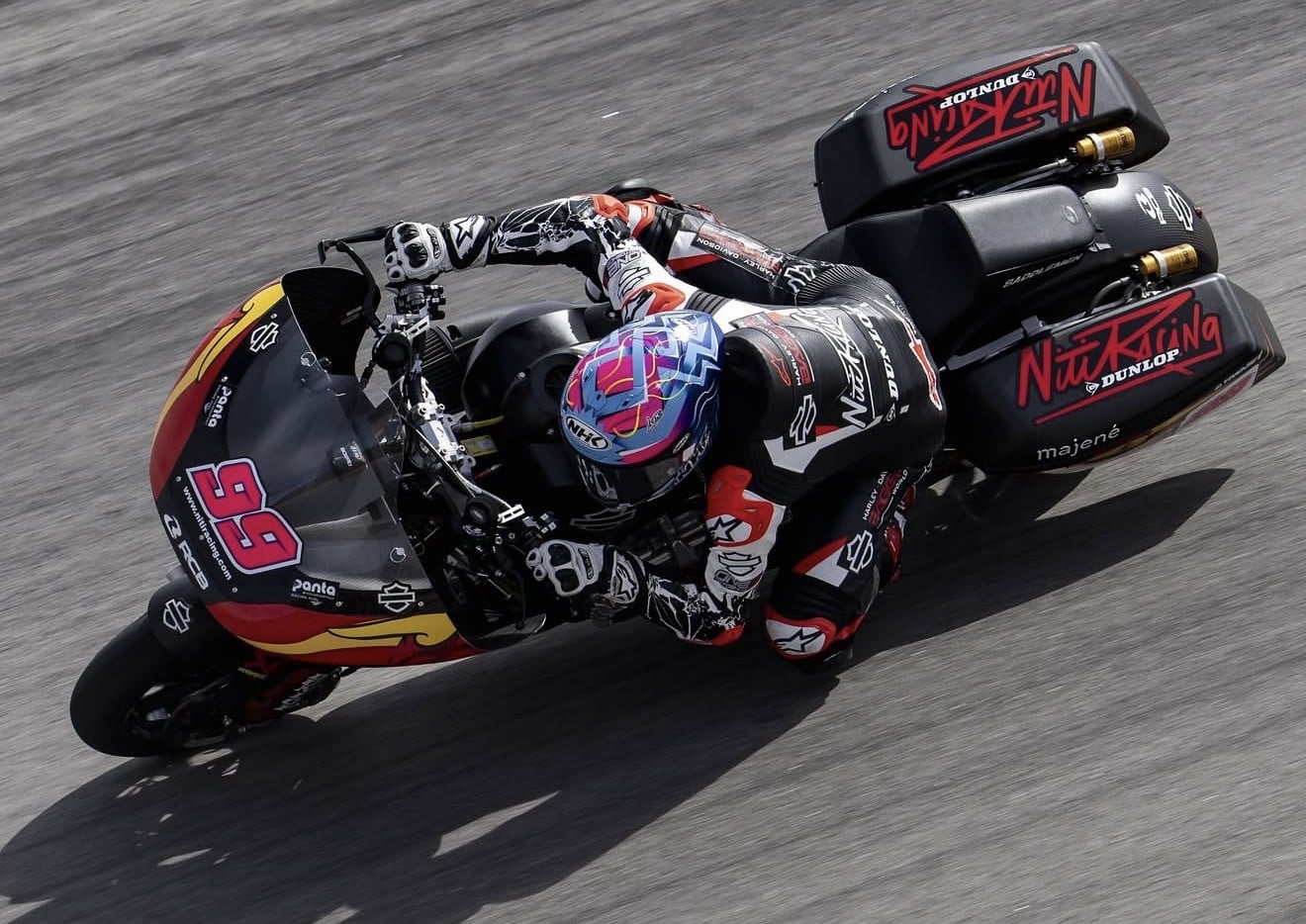
FP2 Results: Gutierrez Sets the Pace
Gutierrez topped the 10-rider field with a lap time of 1:56.926, putting his Niti Racing Harley-Davidson solidly ahead of his teammate Andrea Iannone, who posted a 1:57.201 to go second. Jordi Torres slotted into third on his Joe Rascal Racing Harley-Davidson with a 1:57.649 — less than a second separating the top three. That kind of tightly bunched competition on a 3.15-mile layout tells you everything about how seriously these teams are developing their machines.
It's worth noting that Iannone had been fastest in FP1 earlier the same Friday, which means the Niti Racing squad is working both ends of the setup spectrum and doing it quickly. Two different riders, same team, trading fastest laps across sessions — that's a well-organized program with real data behind it.
For the American contingent, the Saddlemen Racing Harley-Davidson team ran three riders in the session. Max Toth went fifth with a 1:59.119, Travis Wyman placed eighth at 1:59.891 and Jake Lewis finished ninth with a 2:01.321. They're within the conversation but have time to find over a single lap — and in a series run on Dunlop control tires, the margin for gains shifts squarely into suspension, geometry and engine tune.
What MotorLand Aragón Demands From a Bagger
MotorLand Aragón is a 5.08-kilometer (3.15-mile) permanent road course that MotoGP uses as a fixture on its calendar. It's not a flat oval, not a modified street course — it's a proper technical road circuit with significant elevation change, a mix of high-speed flowing corners and tight technical sections, and a surface that punishes bikes with unresolved chassis feedback.
Running a Harley-Davidson touring platform around that layout at 1:56 pace is genuinely remarkable. The stock Road Glide or Street Glide is engineered for comfort over distance, not for lap times. Getting that architecture to behave on a track like Aragón means attacking it from multiple angles — suspension that can handle braking stability and mid-corner composure, an engine tune that delivers clean, predictable power delivery out of slow corners, and tires that are worked into their operating window on what are relatively short straights by MotoGP standards.
Control Dunlop tires level the playing field on rubber, which means the teams doing the most work on bagger suspension and chassis setup are the ones pulling away on lap times. The gap from first to ninth in FP2 was just over four seconds across a 3.15-mile lap — that's a tight, serious field.
The Niti Racing Edge — And What It Tells You About Setup
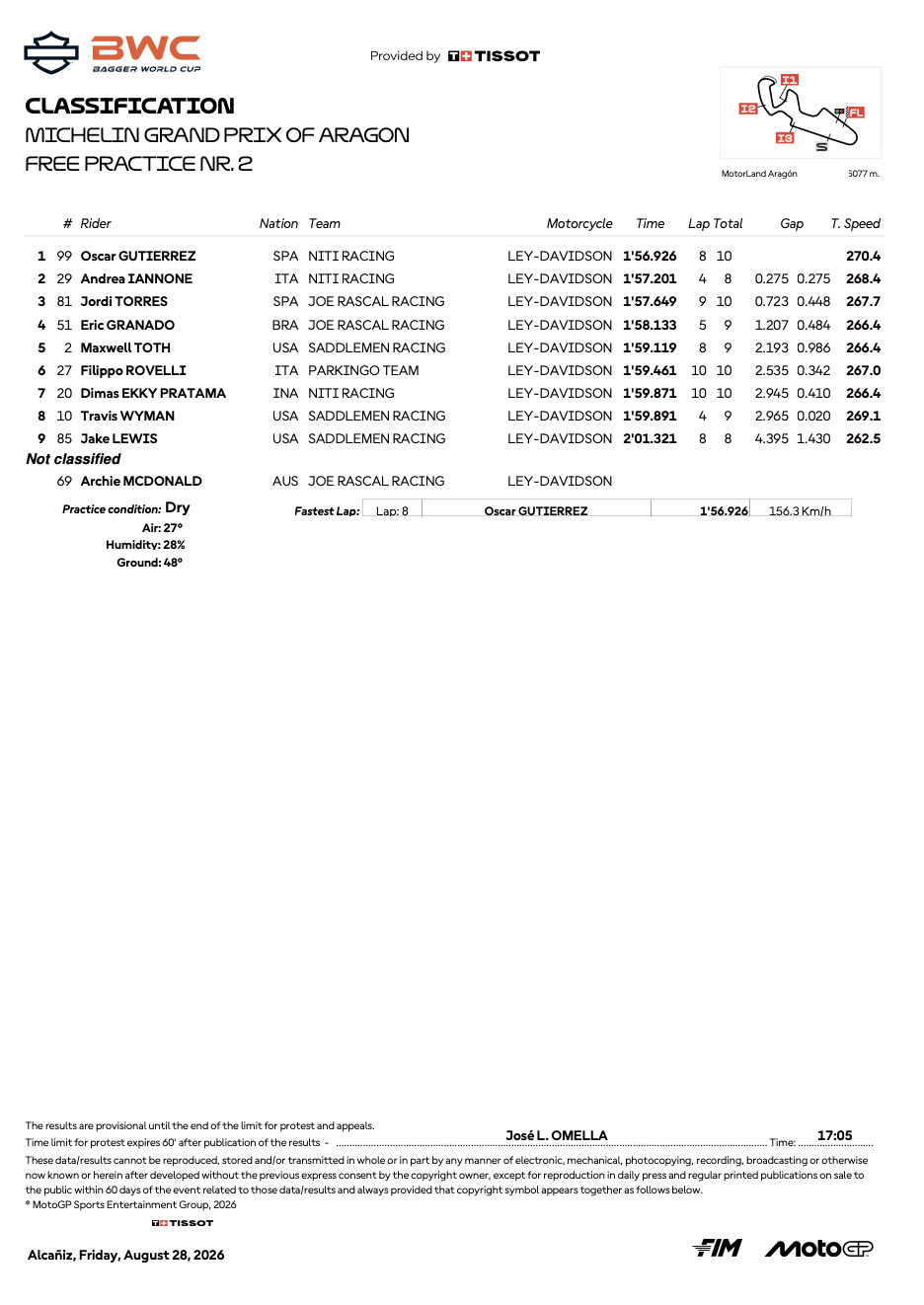
Niti Racing running one-two in FP2 — Gutierrez first, Iannone second — is not luck. These are two experienced, high-level motorcycle racers working on a common platform and extracting the most from it session by session. The fact that Iannone led FP1 and Gutierrez led FP2 suggests the team is trying things between sessions and improving. That's a functioning development loop.
At the professional level, gains on a control-tire series come from a handful of places: engine output, exhaust flow, suspension kinematics and rider position. Your build at home operates on the same principles, just on a different timeline and with different goals — but the physics don't change.
If you're watching these teams and thinking about how to apply the same logic to your Road Glide or Street Glide, start with the systems that limit you most. On a stock Milwaukee Eight, that's usually airflow and exhaust back-pressure. A performance air cleaner and a free-flowing exhaust system are the fastest way to unlock what the engine already wants to do. The Bagger World Cup bikes are obviously built well beyond stock, but every one of those builds started with solving the same basic constraints.
Suspension: The Real Separator at This Level
On a control tire series, you can't buy a faster tire. What you can do is get your suspension working correctly so the tire is loaded and released in a way that maintains contact patch and traction. That's the variable the teams are fighting over, and it's the one that separates a 1:56 lap from a 2:01 lap in a field of this caliber.
For Saddlemen Racing, closing the gap to Niti probably means finding more front-end confidence under braking and getting the bike to rotate through the slower sections of Aragón without unsettling the rear. Those are suspension problems before they're engine problems.
For your build, the same logic applies. If your Road Glide feels loose over highway pavement or vague in corners, you're losing rider confidence before you even get to the power question. Upgrading to a set of performance bagger shocks is the kind of change that transforms how a touring bike feels in a way that more displacement alone cannot. Get the chassis sorted first. The power gains hit differently when the bike is planted.
While you're addressing the rear, don't neglect the front. Stock fork springs on a loaded touring bike are a compromise. Stiffer springs with the right oil weight, or a fully adjustable cartridge setup, give you the braking stability and front-end feedback that makes you confident going deeper into corners. Look at fork upgrade options that are designed specifically for Milwaukee Eight touring platforms — generic fitments won't get you where you want to go.
Engine Tune in a Control-Series Context
The Bagger World Cup runs on Dunlop control tires, but engine specifications in the series allow for significant development. The Milwaukee Eight platform — whether the 114 or 117 — responds well to cam changes, head work, exhaust and fueling. Getting those pieces dialed in with a proper tune on a dyno is how you convert parts into actual power.
A performance M8 cam swap is one of the highest-return engine modifications available on the Milwaukee Eight platform. The stock cams are ground for emissions compliance and broad-range smoothness — not for peak power. Aftermarket grinds with more lift and duration open the engine up in the mid-range and top end where road course acceleration matters most.
Pair a cam change with a performance exhaust that reduces back-pressure and you're forcing the engine to breathe in a fundamentally different way. The tuner on the dyno then has real variables to work with — not just trimming a lean condition on a stock setup, but optimizing fueling for a combination that's actually flowing air and exhaust gas efficiently.
At the Bagger World Cup level, every one of these decisions is made with data. At home, you can get close to that process with a reputable tuner, a good baseline dyno pull and a clear sense of what parts you're combining. Don't mix components from different manufacturers without understanding how they interact — exhaust scavenging, cam timing and air cleaner flow all need to work as a system.
What the American Teams Need to Close the Gap
Max Toth at fifth, Travis Wyman at eighth and Jake Lewis at ninth — that's the American picture in FP2 at Aragón. The gap from Toth to Gutierrez is just over two seconds on a sub-two-minute lap. In road racing terms, two seconds a lap is significant but absolutely closeable with setup work.
Saddlemen Racing has resources and experienced riders. Between FP2 and qualifying, there's data to be mined and setup adjustments to be made. The Aragón track is technical enough that a rider who finds confidence in one or two key corners can pick up the bulk of that time without any mechanical change — but having the right mechanical platform underneath makes finding that confidence possible.
For riders at home who follow the American teams in series like the Bagger World Cup or King of the Baggers, the lesson is the same one that applies to every level of motorsport: time comes from everywhere, not just the engine. The rider who has the right LED headlight setup for visibility, the properly sorted bagger brakes for confidence under hard deceleration, and a chassis that does what it's told — that rider is faster before they even touch the throttle.
Build Your Bagger With the Same Focus These Teams Use
The FIM Harley-Davidson Bagger World Cup running alongside MotoGP at MotorLand Aragón is not a sideshow. It's a legitimate international series running on one of the most demanding road courses in the world, and the lap times these riders are putting in reflect serious machine development. Oscar Gutierrez going 1:56.926 on a Harley-Davidson touring platform at Aragón is the kind of number that reframes what the Milwaukee Eight architecture is capable of when teams commit to developing it properly.
Your build doesn't need a race team budget to benefit from the same thinking. Clear priorities, quality parts, a proper tune and suspension that actually works — that's the formula at every level. Whether you're chasing lap times or just want a Road Glide that performs as hard as it looks, the approach is the same.
Shop our performance exhaust systems and bagger suspension upgrades at vtwinbikers.com — built for riders who take performance seriously, the same way the Bagger World Cup teams do.