

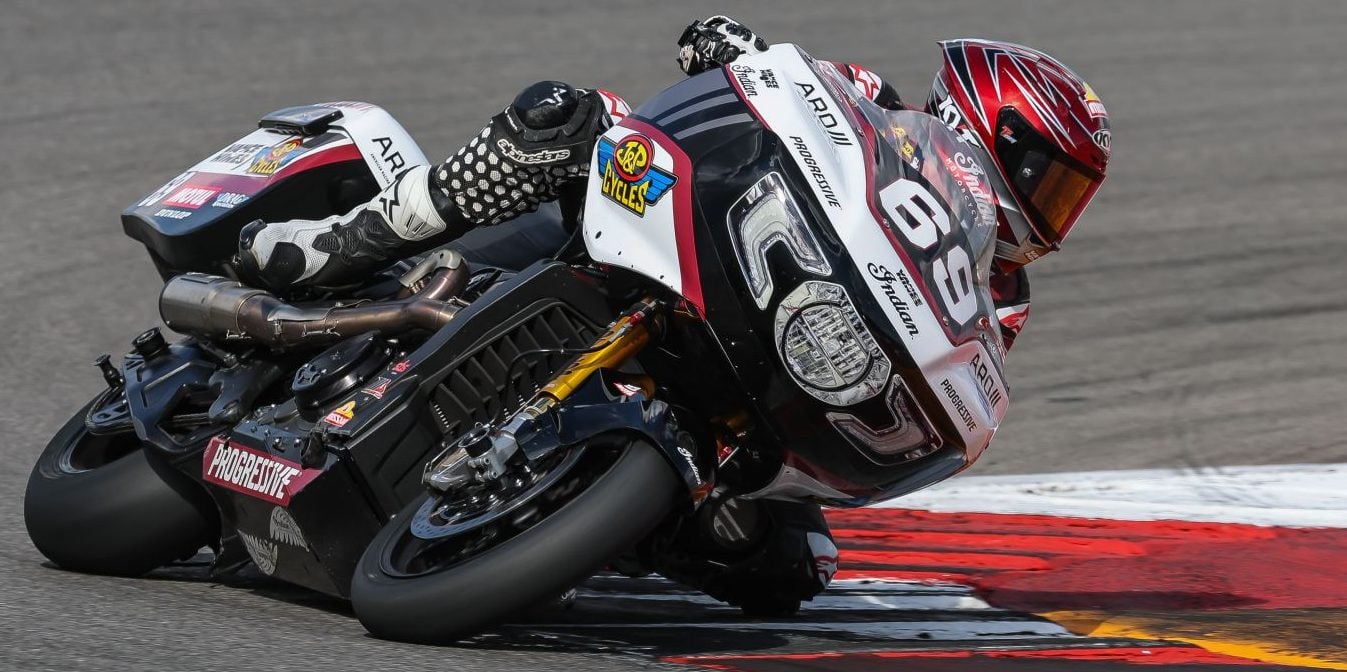
Hayden Gillim punched the J&P Cycles/Motul/Vance & Hines Factory Indian to the top of the MotoAmerica Mission King of the Baggers qualifying sheet at Circuit of The Americas on Saturday, September 12, 2026. Behind him, Bradley Smith lined up second on the Harley-Davidson x Dynojet Factory Racing entry, with Troy Herfoss, Kyle Wyman and Rocco Landers rounding out the top five. Five factory-backed, race-prepped touring bikes separated by fractions of a second around one of the most technically demanding road courses in North America. If you ride a bagger and you think this sport has nothing to teach you about your own machine, look at that qualifying sheet again.
Why COTA Qualifying Results Matter to Your Build
COTA is not a drag strip. The 3.4-mile circuit throws everything at a motorcycle — hard braking into tight hairpins, long sweeping corners that load the chassis for three and four seconds at a time, elevation changes that unsettle suspension mid-corner, and two long straights where top-end power gets sorted from paper horsepower claims. When a King of the Baggers machine goes quick at COTA, it is not a fluke of gearing or a lucky drafting run. That lap time is a complete package: power, chassis, braking, tires and rider confidence working together.
Gillim's pole means the Vance & Hines exhaust program on that Indian is pulling its weight at altitude and in heat. Smith's second-place effort on the Harley-Davidson platform with Dynojet fueling management is a direct signal that exhaust flow and fuel calibration are still the fastest return on investment in bagger racing — and in your garage. What the factory teams spend millions validating, the aftermarket distills into parts you can bolt onto your Road Glide or Street Glide this weekend.
The Vance & Hines Factor
Vance & Hines is the exhaust name on Gillim's pole-winning bike, and that is not a sponsorship logo thrown on a bike for marketing. Vance & Hines has been developing exhaust systems for Milwaukee Eight and Indian PowerPlus platforms in race conditions for years. The data those race programs generate feeds directly into the street and performance catalog.
For your Milwaukee Eight touring bike, proper exhaust flow is the first and most impactful modification you can make. Stock head pipes are designed around emissions compliance and fitment packaging, not scavenging efficiency. A high-flow performance exhaust system opens up the motor's ability to breathe, reduces heat soak around the rider's legs and, critically, gives your tuner a system worth mapping.
If you are running a two-into-one or a full race-inspired header setup, pairing it with a high-flow air cleaner is not optional — it is the other half of the breathing equation. You cannot push more exhaust out the back without pulling more air in the front. The factory teams know this. Every King of the Baggers machine runs a matched intake and exhaust combination. Your street build should operate by the same logic.
Bradley Smith, Dynojet and the Fueling Conversation
Bradley Smith's second-place qualifying run on the Harley-Davidson x Dynojet Factory Racing machine puts a spotlight on something every Milwaukee Eight owner needs to understand: a performance exhaust without a proper tune is money left on the table and potential engine damage waiting to happen.
Dynojet's involvement at the King of the Baggers level is not coincidental. Power Commander and fuel management technology is the bridge between a bolt-on exhaust and an engine that actually makes peak power across the entire RPM range. When you open up the exhaust and intake on your M8, the stock fueling map is suddenly calibrated for a configuration that no longer exists on your bike. The engine runs lean. Power drops off in the midrange. You may pass an emissions sniff but you are not making the power the motor is capable of.
A fuel management tuner closes that gap. Whether you go with a piggyback Power Commander, a full flash tune or a standalone ECM solution, getting your fueling dialed after exhaust and intake work is the single most important step between a modified bike and a fast modified bike. The King of the Baggers field does not leave fueling to chance, and neither should you.
What the Top-Five Qualifying Order Tells Us About Platform Parity
Look at the top five again: Gillim (Indian), Smith (Harley-Davidson), Herfoss (Indian), Wyman (Harley-Davidson), Landers (Indian). Three Indians, two Harleys, alternating positions. That is not random. That is two well-funded, well-developed factory programs running nearly identical lap times at a world-class circuit in 2026.
From a parts standpoint, that platform parity is good news for you. The development race between the Indian Challenger and the Harley-Davidson touring platform has driven serious engineering investment into suspension, brakes, tires, cam profiles, and chassis components on both sides. The parts filtering down from those programs into the street performance catalog are better than anything available five years ago.
If your Harley-Davidson touring bike is still on stock suspension, you are riding on hardware that was designed for a 90th-percentile touring rider, not for someone who wants to push through corners. The factory King of the Baggers machines run fully adjustable suspension front and rear. Your street build does not need a full race shock, but it does need something better than stock. A set of performance bagger shocks and a front suspension upgrade will change how your motorcycle handles more than almost any other single modification — and COTA lap times prove that suspension is not secondary to horsepower in this class.
Cam Timing, Compression and Where Pole Lap Power Actually Comes From
Polished lap times at a circuit like COTA are built on torque, not just peak horsepower. Milwaukee Eight and PowerPlus engines produce strong low-to-mid RPM torque in stock trim. Race teams optimize that power band further through camshaft selection and compression tuning to put usable power exactly where the rider needs it — at corner exit, under hard acceleration from 40 mph to 100 mph in the mid-circuit sweepers.
For your M8 114 or M8 117, an upgraded cam package is one of the most cost-effective ways to reshape your power curve. A performance Milwaukee Eight performance cam moves peak torque into the RPM range where you actually ride — not up in the power band where the dyno sheet looks impressive but your throttle hand never goes on the street. The King of the Baggers race teams select their cam profiles for the circuit layout. You should select yours for how and where you ride.
Complementing cam work with higher-compression pistons or a displacement increase compounds the gains. If you are building past cams and exhaust, a big bore kit takes the foundation work you have already done and multiplies the output. These are not modifications exclusive to race bikes — they are the same logic applied at different power levels.
Brakes: The Underrated Lap Time Variable
Every second Gillim gained on his pole lap, he also had to give back at the end of a straight. COTA's Turn 12 hairpin and the approach to Turn 1 demand serious braking performance from machinery this heavy. King of the Baggers bikes are not lightweight — they are full-size touring machines carrying substantial front-end mass at 150-plus miles per hour. Stopping them repeatedly, consistently, without brake fade, is a genuine engineering challenge.
Upgraded bagger brake rotors and pads are not a vanity upgrade on a performance touring build. Whether you are chasing a track day lap time or just want confident braking on a fast canyon road, your stock rotors and pads are calibrated for OEM performance, not the thermal loads that come with aggressive riding. A larger rotor, better pad compound and braided stainless lines give you a firmer, more progressive lever feel and more consistent fade resistance. The factory teams run full brake packages for a reason — heat management and repeatability.
Building Your Own Pole-Position Bagger
Gillim's pole at COTA is a benchmark, not a ceiling. The modifications that put factory Indian and factory Harley-Davidson machinery at the top of that qualifying sheet are available, in street-legal or track-day form, for your touring bike right now. Exhaust, intake, fueling, suspension, cam timing, brakes — each of those systems has an upgrade path, and each upgrade compounds with the next. You do not need a factory budget to feel the difference. You need the right parts in the right order.
Start with the breathing: exhaust flow and air cleaner first, tune second. Move to suspension so the power you are making actually translates into forward motion instead of wheel spin and chassis flex. Then address the cam, compression, and braking systems as your budget and build goals allow. Every King of the Baggers machine on that COTA qualifying sheet started with those same fundamentals.
Your Road Glide, Street Glide or Indian Challenger deserves the same treatment the factory teams give their race bikes. Shop our performance exhaust systems and our full catalog of bagger performance parts at vtwinbikers.com and start building your own qualifying-worthy machine today.