

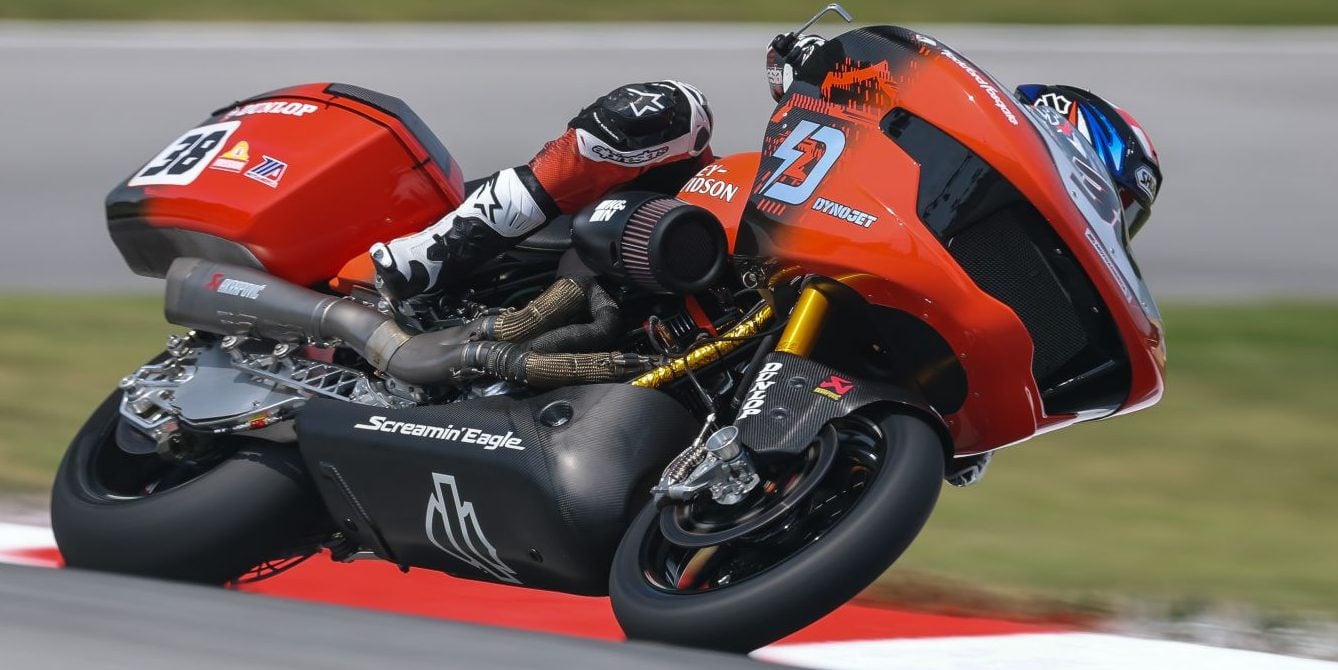
Bradley Smith walked into Circuit of The Americas on Friday and made one thing perfectly clear: the Harley contingent isn't here to make up numbers. Smith's provisional pole lap in MotoAmerica King of the Baggers qualifying put the Harley-Davidson x Dynojet Factory Racing bike at the top of the sheet, with a stacked Indian lineup chasing hard. If you've been watching this series evolve and wondering what it takes to keep pace with the factory teams, the answer starts with a full exhaust system and a serious look at everything else on your touring bike that's leaving power on the table.
The Qualifying Sheet: What Friday Told Us
Smith topped qualifying to take the Mission King of the Baggers provisional pole. Behind him, J&P Cycles/Motul/Vance & Hines Factory Indian's Hayden Gillim slotted into second — a result that keeps the Harley vs. Indian battle exactly where fans want it: close, tense and unresolved heading into race day. Smith's Harley teammate Kyle Wyman locked in third, which means the factory Harley squad occupies two of the top three spots on the grid.
Gillim's Indian teammates Troy Herfoss and Rocco Landers rounded out the top five, making the back half of the top five an all-Indian affair. That's a formidable lineup from the Vance & Hines-backed camp — Herfoss brings road racing credentials that go well beyond the bagger world, and Landers has shown flashes of genuine brilliance in this series. The race itself is going to be decided in braking zones and corner exits, not straightlines, and that's exactly the kind of racing that makes King of the Baggers worth watching.
Why COTA Is a Legitimate Test for Bagger Technology
Circuit of The Americas is not a track that forgives mechanical deficiencies. The 3.41-mile layout throws everything at a motorcycle — high-speed sweepers that load tires mercilessly, heavy braking into tight hairpins, and a series of technical esses that demand chassis composure. The fact that baggers — full-dress touring motorcycles — are circulating this track at race pace is still, if you step back and think about it, genuinely remarkable.
For the factory teams, that means the suspension package has to be dialed to a razor's edge. The geometry changes, the damping curves, the spring rates — all of it has to work in concert with a machine that started life as a cross-country tourer. For your own build, the lesson is the same: performance bagger shocks aren't a luxury upgrade. They're the difference between a bike that responds to your input and one that fights you through every corner.
Braking is the other conversation nobody wants to have until their stock setup reminds them at the worst possible moment. The factory teams run purpose-built brake packages. On your bike, that starts with high-performance brake pads and, if you're serious about stopping power, a look at braided lines and upgraded rotors that can handle real heat cycles without fade.
Smith's Harley: What Makes a Factory Bagger Fast
The Harley-Davidson x Dynojet Factory Racing machine isn't just a Road Glide with a stage kit slapped on it. These bikes go through extensive development — engine work, chassis modification, suspension, aerodynamics. But the foundation of speed in this class is still the Milwaukee Eight platform, and the principles that make the factory bike fast are the same ones that make YOUR Road Glide faster.
It starts with airflow. The Milwaukee Eight responds aggressively to breathing modifications. A high-flow air cleaner is the first bolt-on that actually moves the needle — not because it looks good (though it does), but because the stock airbox is genuinely restrictive. Pair that with a free-flowing exhaust and you've fundamentally changed how the engine breathes on both ends of the combustion cycle.
The Cam Question
Beyond bolt-ons, the cam is where Milwaukee Eight power really opens up. The stock cam profile is conservative — engineered for emissions compliance and broad rideability across the widest possible range of conditions. A performance cam grinds for more lift and duration, and the torque curve you get in return is something you feel immediately in the seat. If your Road Glide or Street Glide is still running the stock camshaft, a Milwaukee Eight performance cam is the single highest-impact internal modification you can make without splitting cases.
Fueling and Tuning: The Multiplier
None of the above — cam, air cleaner, exhaust — works at its full potential without proper fueling. The factory teams aren't making peak power on a stock ECU map, and neither will your bike. A Dynojet Power Vision tuner lets you run a custom map that accounts for every modification you've made. Off-the-shelf maps can get you close, but a dyno session with a tuner who knows the Milwaukee Eight platform is what separates a bike that runs well from one that runs exactly as fast as it should.
Gillim, Herfoss, Landers: The Indian Threat Is Real
Let's not bury the lead on the Indian side of this equation. Hayden Gillim is a proven winner in this series, and the J&P Cycles/Motul/Vance & Hines Factory Indian operation is one of the most professional teams in American road racing — full stop. Gillim qualified second, which means he has a front-row starting position and a clear shot at Smith in the opening laps before traffic becomes a factor.
Troy Herfoss, meanwhile, is a former Superbike World Championship contender. The man can ride. Slotting him into a bagger and pointing him at a track like COTA is not a mismatch — it's a weapon. Rocco Landers in fifth rounds out a top-five that reads like a Who's Who of current American road racing talent.
For Harley riders watching this, the competitive intensity from the Indian camp is exactly the pressure that drives development. The modifications that make it from the race paddock to production parts — better exhaust flow, improved suspension geometry, refined fueling — exist because teams like Vance & Hines spend weekends like this one finding tenths and hundredths wherever they can.
What the Race Setup Tells You About YOUR Build
Here's the translation from paddock to street — or street to track, if that's where your Road Glide or Street Glide is headed.
The exhaust package matters more than almost anything else you can do to a bagger. The factory teams run full exhaust systems that are engineered for both flow characteristics and back-pressure management at racing rpm. For your build, a full performance exhaust system addresses both of those things and does it in a way that a slip-on alone simply cannot. If you're running a slip-on right now and wondering why you're not feeling the power gains the internet promised you, the header pipe is your answer.
Suspension is next, and it goes both directions — front and rear. The front end on a stock touring bike is valved for comfort, which is exactly the wrong priority the moment you start pushing cornering speed or carrying real corner speed through sweepers. Front fork cartridge kits revalve and respring your forks for actual performance use without requiring a full fork swap. Combined with rear shocks calibrated to your riding weight and style, the chassis transformation is significant.
Tires are the final contact patch between every single one of those modifications and the road surface. Dunlop's Sportmax Slicks are the official tire of the MotoAmerica Series for a reason — the compound and construction are engineered for maximum grip under race conditions. For street use, the Dunlop performance street lineup carries that same development lineage into DOT-legal form.
Race Day: What to Watch For
When the lights go out for the Mission King of the Baggers race at COTA, the first three corners are going to tell you almost everything you need to know about how this plays out. Smith on pole with Gillim right behind him means the Harley vs. Indian battle is going to be immediate and physical. Kyle Wyman in third gives the Harley-Davidson x Dynojet squad a strategic asset — two bikes near the front can be used to control pace, cover moves, and force the Indian side into reactive riding.
Herfoss and Landers in fourth and fifth have the pace to be factors deep into the race. COTA is punishing on tires over a full race distance, and tire management late in the race has decided King of the Baggers results before. A rider who's been nursing his front tire through the technical sector could find himself with grip the leaders don't have in the final laps.
This is the kind of racing that has made King of the Baggers one of the most talked-about series in American motorsport. Real bikes. Real competition. Real stakes.
Take What the Factory Teams Know and Build Yours
Smith's provisional pole at COTA is a reminder of what this platform is capable of when it's properly developed. The Milwaukee Eight touring bike — Road Glide, Street Glide, it doesn't matter — has more performance potential than most riders ever unlock, because most riders stop at a slip-on and a tune and call it done. The factory teams don't stop there, and neither should you.
Start with the exhaust, feed the engine clean air, put the right cam in it, tune it properly and then get the chassis underneath all of that power doing what it needs to do. Every piece of that equation is available right now. Shop our performance exhaust systems at vtwinbikers.com and pair it with a high-flow air cleaner to start building the kind of bagger that belongs on a track like COTA — not just a road.