

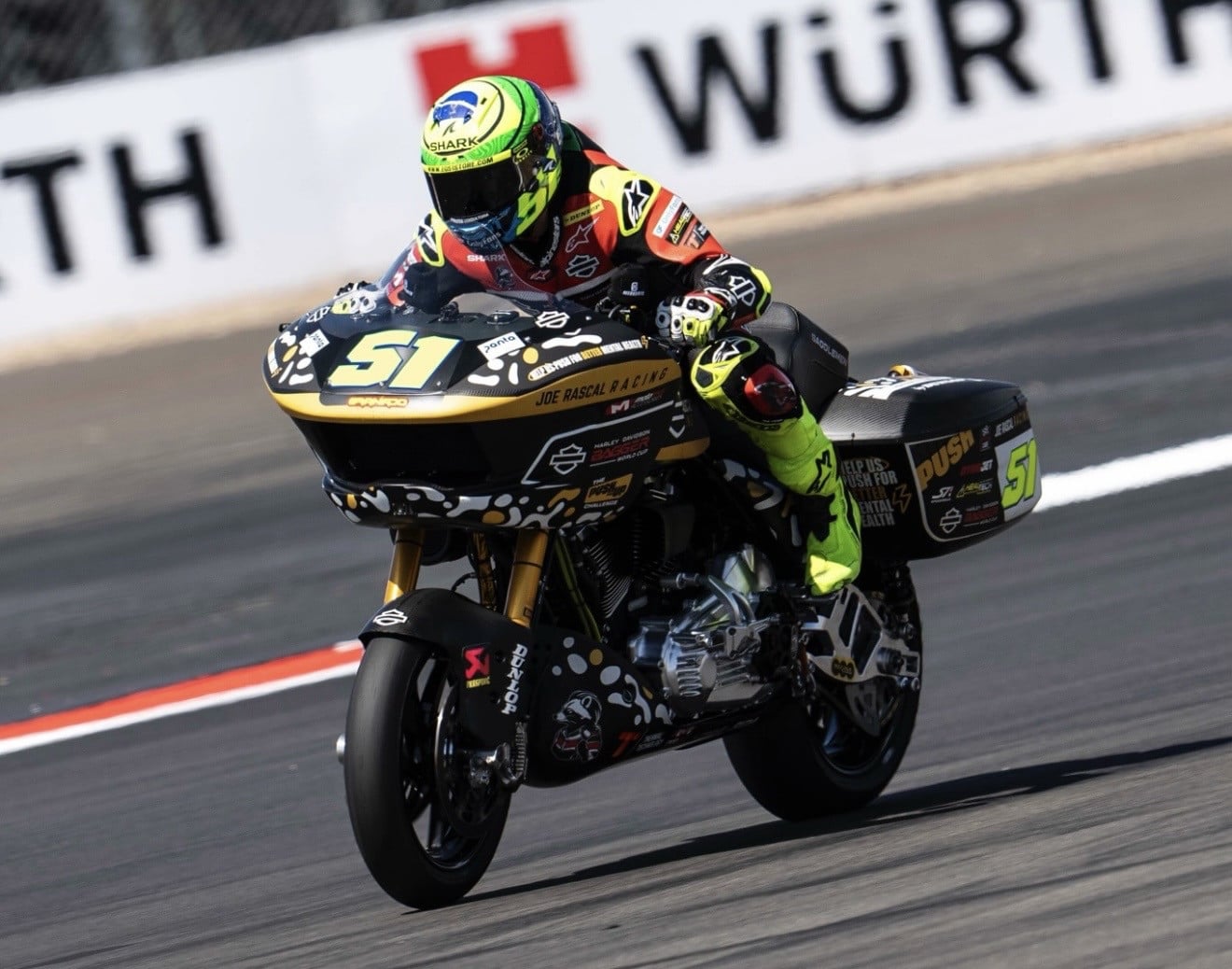
Eric Granado just reminded the world that a Harley-Davidson bagger isn't a parade bike — it's a race machine. On Friday morning at Silverstone Circuit in England, the Brazilian rider aboard his Joe Rascal Racing Harley-Davidson posted a 2:10.523 lap around one of motorsport's most demanding 3.67-mile road courses, putting him at the top of the Bagger World Cup FP1 timing sheet. If you've been watching the King of the Baggers scene in the States and wondering when this format was going to go global, the answer is: it already has. And the hardware running up front looks a lot like what's sitting in your garage right now — which means the lessons coming out of Silverstone matter directly to your build.
What the FIM Bagger World Cup Actually Is
The FIM Harley-Davidson Bagger World Cup is exactly what it sounds like: a spec-adjacent, international road racing series built around H-D touring platforms running on Dunlop control tires. This isn't a show class or a parade lap — it's a timed, competitive session held at the same venues as MotoGP rounds, which in this case means Silverstone, one of the fastest and most technical circuits on the calendar. The field at this round numbered 11 riders from multiple countries, and the lap times are eye-opening. Covering 3.67 miles in 2 minutes and 10 seconds on a touring-class motorcycle demands serious power, serious suspension and serious brakes. The racing format puts a premium on every single component that you'd upgrade on a street performance bagger — because at this level, compromise kills lap time.
The control tire rule (Dunlop across the board) levels the grip equation, which means the teams that find time do it through engine output, aerodynamics, suspension calibration and rider skill. Sound familiar? That's the same pecking order that separates a well-built road bagger from a stock one.
Granado Sets the Pace — Here's the Gap
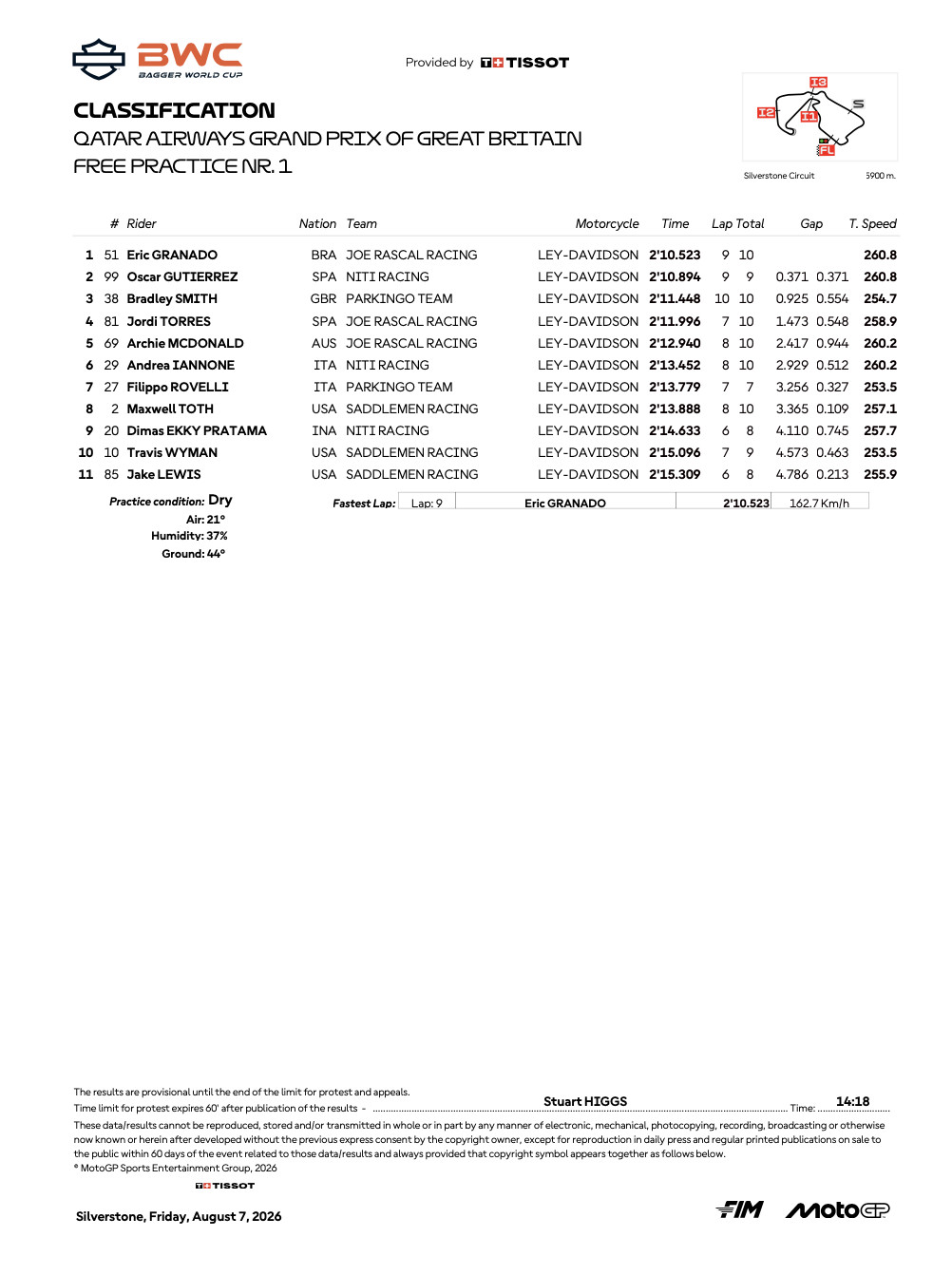
Granado's 2:10.523 was quick enough to beat Oscar Gutierrez of Niti Racing by 0.371 seconds — tight enough to make FP1 competitive, but Granado was clearly in a different rhythm. Third went to Bradley Smith on his ParkinGO Team Harley-Davidson at 2:11.448, giving the home crowd at Silverstone something to cheer about in the early session.
On the American side of the ledger, the Saddlemen Racing Harley-Davidson outfit brought three riders to England. Max Toth ran an 8th-place 2:13.888, Travis Wyman logged a 2:15.096 for 10th and Jake Lewis rounded out the field in 11th with a 2:15.309. The gap between Granado and the Saddlemen trio is roughly three to five seconds — on a world-class circuit, that's meaningful ground to make up, and it shows how wide the performance ceiling is even within the same platform.
For the American riders, the international circuit experience and the calibration time on a new track likely plays a role. Silverstone's combination of fast, flowing corners — Copse, Maggotts, Becketts — puts enormous demand on front-end feel and mid-corner stability, two areas where suspension tuning on a touring platform separates the good builds from the great ones.
Suspension: The Silent Separator at Silverstone
You can't watch a Harley-Davidson touring bike hold its line through Maggotts-Becketts at speed and not think about suspension. Those corners are where MotoGP bikes run 150+ mph and change direction three times in rapid succession. The Bagger World Cup machines doing it on H-D iron are running far more sophisticated suspension setups than anything that left Milwaukee on a stock bike. Front and rear geometry is dialed, spring rates are matched to the track surface and the rider's weight, and rebound damping is set to manage the chassis loads a high-speed road course generates.
For your street build, the principle is the same — just scaled to the demands you actually face. If your Road Glide or Street Glide is still running stock suspension, you're leaving performance on the table every single time you push through a canyon or carve an on-ramp. Upgraded rear shocks for touring baggers are one of the highest-return modifications you can make, and the data coming out of Silverstone-level competition only reinforces that. Pair that with a quality front fork spring kit to balance the front-to-rear feel and you'll notice the difference the first time you push the bike hard.
Power: What's Moving These Bikes Around a 3.67-Mile Circuit
The Bagger World Cup doesn't publish a detailed rulebook in this report, but the platform is Milwaukee Eight-based H-D touring hardware — and at this level, you can bet the teams are extracting every cubic inch of advantage the rules allow. Race-prepped M8 motors at this tier run aggressive cam profiles, ported heads, high-compression pistons and full exhaust systems tuned for peak power delivery. The goal is the same whether you're chasing a lap record at Silverstone or trying to close a gap on the freeway: more air in, more exhaust out, combustion that happens at the right time.
For street performance builds, the path is proven. A high-lift performance cam for Milwaukee Eight is the single best internal modification you can make to an air-cooled or Milwaukee Eight 114/117/131 motor — the stock cam profiles are conservative, and there's significant power sitting on the table from the factory. Combine that with a high-flow air cleaner to feed the engine properly and a full performance exhaust system to let it breathe on the other end, and your dyno numbers will tell the story. These aren't theoretical gains — they're the same recipe that racing programs have been running at every level of bagger competition for years.
Tires, Brakes and the Control Tire Reality
The Dunlop control tire mandate in the Bagger World Cup is worth dwelling on for a moment. When every rider in the class is on identical rubber, the grip equation is equalized — which means the teams that find lap time aren't doing it through tire compound trickery. They're doing it through power delivery, brake performance and the ability to put the tire to work consistently.
Brakes on a bagger built for performance need to be able to haul the bike down from speed repeatedly without fade. At Silverstone, that means hard stops into Brooklands, Luffield and the Vale complex — corners where late braking is a passing opportunity and brake confidence is everything. On the street, that same principle applies every time you encounter an emergency stop or need to trail-brake into a tight corner. Upgraded brake pads and properly bedded rotors are not optional equipment on a performance build — they're table stakes.
The tire picture for street riders is different — you have choices the Bagger World Cup field doesn't. The right tire for your riding style, geography and bagger setup can make a substantial difference in how the bike communicates with the pavement, which directly affects your confidence and your lap times, literal or figurative.
What the American Saddlemen Riders Face Going Forward
Max Toth, Travis Wyman and Jake Lewis represent the Stars-and-Stripes contingent at this round, and their times place them in the back half of an 11-rider field. That's not a knock — bringing competitive touring iron to an international MotoGP support class and turning laps at Silverstone is an achievement in itself. But the gap to the sharp end of the field, roughly three seconds to Granado's benchmark, is the kind of deficit that gets closed through incremental improvements in setup, familiarity with the circuit and potentially more aggressive tuning strategies.
The Saddlemen Racing name will be familiar to anyone who's followed the domestic King of the Baggers scene — Saddlemen is a seat and accessories brand that's embedded in the bagger performance world. Seeing their riders on the international stage reinforces how much the American bagger racing ecosystem has grown since King of the Baggers kicked off the format at Daytona and then expanded to MotoAmerica rounds. The infrastructure, the sponsorship, the rider talent — it's all pointing at a global competitive structure that looks increasingly serious.
For the rest of FP1 and into qualifying and the race, look for the Saddlemen riders to work through their setup notes and chip away at the gap. Track familiarity matters enormously at a circuit like Silverstone.
Building Your Own Silverstone-Inspired Performance Bagger
You're probably not racing at Silverstone next weekend, but the engineering logic that separates Granado's pole-position pace from a stock Harley-Davidson touring bike is the same logic that separates a properly built street performance bagger from a bike that leaves power, handling and stopping performance on the table. Every system on a race-prepped Bagger World Cup machine — engine, exhaust, suspension, brakes, fueling — has a street-legal, bolt-on equivalent that will transform how your Road Glide or Street Glide performs.
The racers at Silverstone are running the proof of concept at the highest level the format has ever seen. Your job is to apply those lessons to your build. Start with the easy wins — airflow, exhaust, suspension — and work toward the bigger internal modifications as your build evolves. The platform is capable. The parts exist. The only question is how far you want to take it.
Shop our performance exhaust systems and bagger suspension upgrades at vtwinbikers.com and start closing the gap between your street build and what's running at the front of the Bagger World Cup field.