

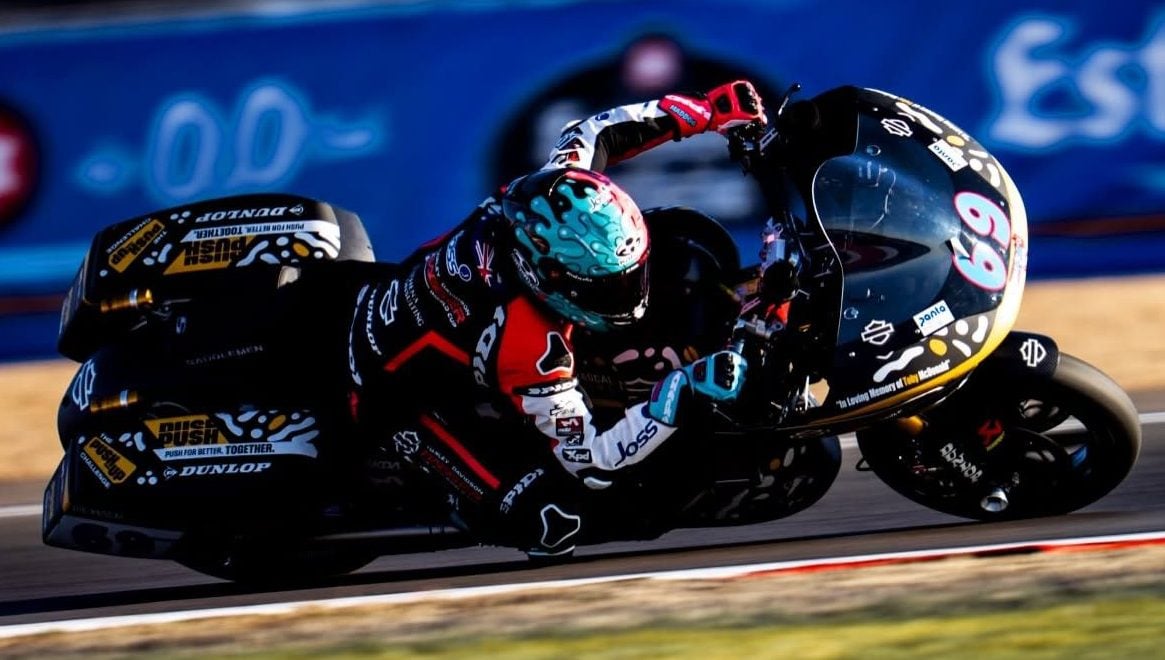
Bagger racing just showed up at one of motorsport's most storied venues — and it didn't apologize for being there. Archie McDonald put his Joe Rascal Racing Harley-Davidson on pole at Silverstone Circuit, turning a 2:08.832 lap around 3.67 miles of fast, technical British tarmac to lead a field of 11 riders in FIM Harley-Davidson Bagger World Cup qualifying. If you needed proof that the bagger racing movement has gone truly global, this is it. And if you're building or tuning your own touring rig, the technology and philosophy behind these race bikes has everything to teach you.
What Just Happened at Silverstone
Silverstone is not a track that forgives. Maggots, Becketts, Chapel — a sequence of high-speed sweepers that punishes any bike that won't commit — followed by the long Hangar Straight where top speed is everything. The fact that a field of Harley-Davidson touring bikes turned competitive laps around this circuit is a statement about how far bagger performance engineering has come.
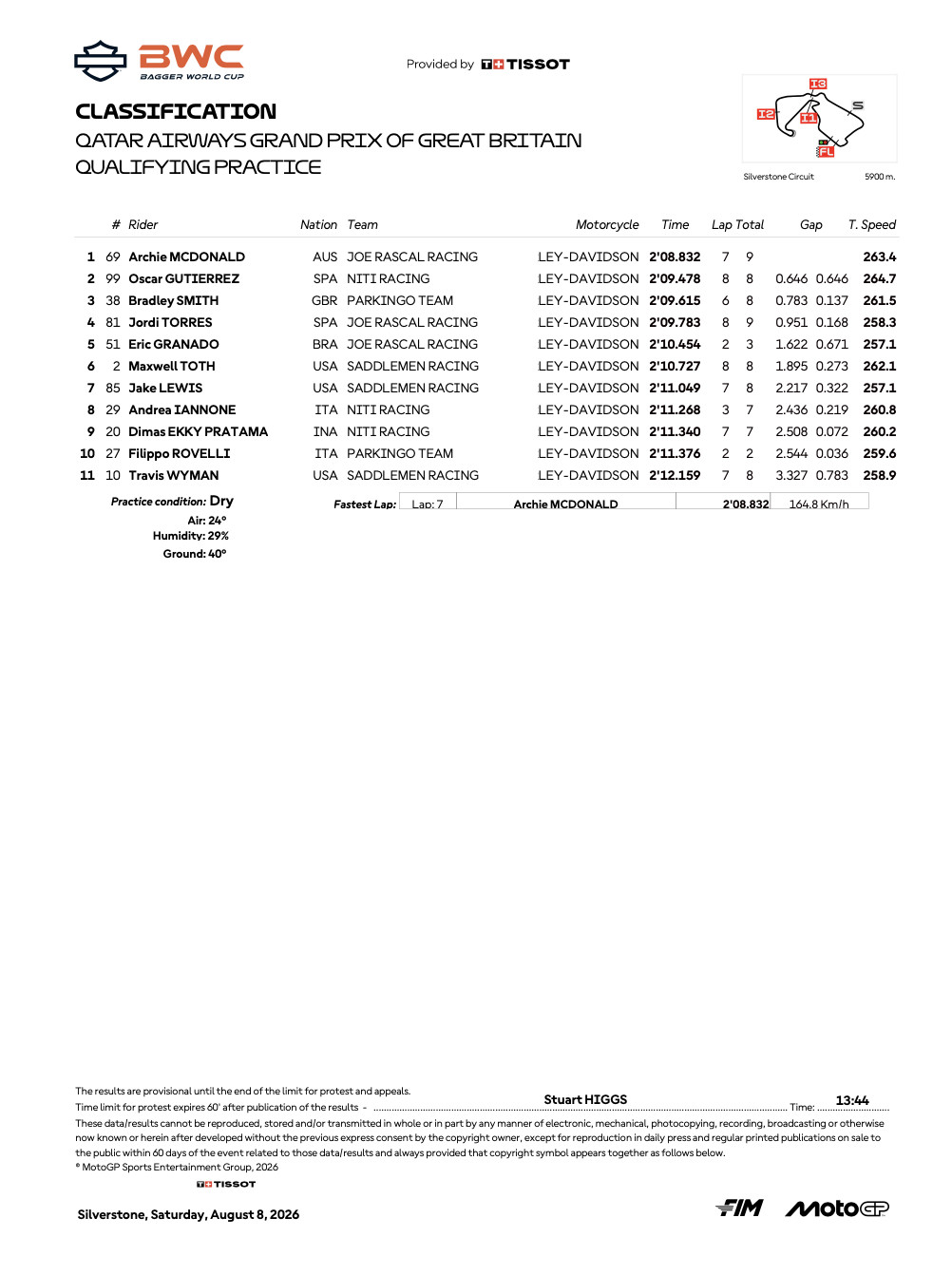
McDonald's 2:08.832 pole lap topped Oscar Gutierrez on the Niti Racing Harley-Davidson (2:09.478) and home-crowd favorite Bradley Smith on the ParkinGO Team Harley-Davidson (2:09.615). The gap from first to third is less than a second — that's a genuinely competitive qualifying session, not a parade.
The American Saddlemen Racing Harley-Davidson squad had a mixed afternoon. Jake Lewis qualified seventh at 2:11.949 and Travis Wyman slotted 11th at 2:12.159 — both within striking distance of the front. Max Toth showed a 2:19.727 for sixth, suggesting he may have had a disrupted flying lap. All three riders are in the mix for the race.
Every bike in this field runs Dunlop control tires, meaning the separation between riders comes down to chassis setup, engine output and rider execution — no tire-lottery variables. That's a setup philosophy that mirrors what the best shop builds are chasing: a balanced package where every component is doing its job.
The Engineering Behind a World-Class Bagger Lap
To run a 2:08 at Silverstone on a touring bike, you are not riding a stock Road Glide with a slip-on. These machines are engineered from the ground up around the Milwaukee Eight platform, and every system is optimized for the demands of a road circuit at race pace.
Start with breathing. A high-flow performance air cleaner is the first bolt-on that separates a tuned bagger from a stock one. At race pace, your engine is pulling air constantly — restricting intake flow is leaving power on the table at every point in the rev range. The World Cup machines are running fully developed induction systems, and the principle translates directly to your street or strip build.
Next is the exhaust. Backpressure is the enemy of peak power on a Milwaukee Eight. The race teams running at Silverstone are not choking their motors with touring pipes — they're running purpose-built race exhausts that evacuate spent gases as fast as the motor can push them. A properly specced performance exhaust system on your touring bike can unlock significant gains in mid-range torque and top-end pull, especially once you're tuned to match.
Camshafts and the Milwaukee Eight Power Curve
Stock Milwaukee Eight camshafts are ground for emissions compliance and low-RPM street rideability. That's fine for commuting. It is not fine if you want to compete at any level — or if you simply want your bagger to feel alive when you crack the throttle at highway speed.
The cam profile controls how long and how wide your intake and exhaust valves open. More duration and lift, dialed in for the right RPM window, means more air-fuel charge in and more exhaust out — which means more power. World Cup race teams are running aggressive cam specifications optimized for their engine builds, and the aftermarket has developed excellent street-legal and competition Milwaukee Eight camshafts that dramatically change the character of your motor.
Pair a cam upgrade with your air cleaner and exhaust work, and you have the foundation of a real performance build. But none of it means anything without the tune to match.
Tuning: The Part Most Riders Skip
Here's where a lot of bagger builds stall. A rider bolts on an exhaust, drops in a cam, installs a new air cleaner — and then rides the bike with the stock fuel map. The result is a bike that's worse than stock: lean, surging, and potentially damaging to the engine over time.
Every modification you make to the induction or exhaust system changes the air-fuel equation. The ECM needs to be retold what the motor is eating. A fuel management tuner is not optional on a modified touring bike — it is the component that makes everything else work. Whether you're running a Screamin' Eagle Pro Street Tuner, a Dynojet Power Vision or another platform, get your bike tuned. Dynoed and tuned if possible. The World Cup teams aren't guessing at their fuel maps, and neither should you.
This is not a marginal upgrade. A proper tune on a modified Milwaukee Eight can be the difference between a bike that's responsive and powerful versus one that's sluggish and temperamental at cruise RPM.
Suspension: Silverstone Demands It, Your Street Ride Rewards It
Silverstone is smooth by road standards but still demands a suspension package that tracks accurately at high speed and absorbs imperfections without upsetting the chassis. Bagger World Cup teams are running developed suspension setups front and rear — not stock rubber.
For your build, this means the same philosophy applies. The stock suspension on a Harley-Davidson touring bike is engineered to a price point and a comfort target. If you're adding power and riding harder — or simply carrying a passenger and gear while maintaining pace — stock suspension becomes the weak link fast.
Replacing your rear shocks with quality performance units changes how your bike handles weight transfer under acceleration and braking. Quality performance bagger shocks from manufacturers who build for the Harley touring platform will give you better tracking, more consistent feel and a bike that actually responds to your inputs instead of wallowing through corners.
Front-end work matters just as much. Progressive springs, upgraded fork fluid or a cartridge emulator kit will transform turn-in and braking stability. The teams at Silverstone aren't leaning on stock forks at 140-plus mph down the Hangar Straight, and your setup deserves the same respect.
Brakes at Race Pace — and Why Street Riders Should Care
Silverstone has genuine heavy-braking zones — Brooklands, Luffield, the approach to Village. Bagger World Cup machines are running upgraded brake systems capable of shedding serious speed from serious velocities, repeatedly, without fade.
Your touring bike's braking system is one of the most important performance investments you can make, and it's one most riders neglect entirely. Upgraded performance brake pads with better bite and heat resistance, stainless braided brake lines that eliminate the spongy feel of stock rubber hoses, and properly bedded rotors will make your bike stop dramatically better than stock — which matters whether you're on a race circuit or dealing with an emergency stop on the highway.
The Bagger World Cup is a race series. But the lessons it teaches about brake performance apply directly to real-world riding.
American Teams at Silverstone: The Global Picture
The Saddlemen Racing Harley-Davidson program brought three American riders to Silverstone — Max Toth, Jake Lewis and Travis Wyman — and while none of them split the front three in qualifying, all are within reach of the points in the race. Jake Lewis at 2:11.949 is less than three seconds off McDonald's pole time around a 3.67-mile circuit. That is a tight race.
What the Saddlemen program represents, alongside the Niti Racing and ParkinGO Team efforts and McDonald's Joe Rascal Racing entry, is a genuinely international grid of competitive bagger builds all fighting under FIM sanction. King of the Baggers lit the fuse domestically. The Bagger World Cup is the international detonation.
For the performance bagger community in the US, watching this series develop matters. The technology being developed and validated on these circuits — cam specs, suspension geometry, braking systems, fuel management strategies — flows back into the aftermarket parts that end up on your bike. Racing improves the breed. That's not marketing copy, it's how it has always worked in motorsport.
What Silverstone Qualifying Means for Your Build
Archie McDonald's pole lap at Silverstone is more than a race result. It's a proof of concept for an entire approach to building Harley-Davidson touring bikes. The platform is capable. The aftermarket is capable. The question is whether your bike is built to take advantage of what's available.
If your touring bike is still running stock air, stock exhaust and a stock tune, you're riding a machine that's been deliberately restricted by the factory to meet a price point and a regulatory requirement. Every bolt-on in this article exists because riders and race teams found out what's on the other side of those restrictions — and it's considerably more fun.
Start with the fundamentals: intake, exhaust, fuel management. Layer in cams when you're ready to step up. Address suspension and brakes so your chassis can handle the power you're building. Every piece compounds the one before it.
The Bagger World Cup field at Silverstone is running a version of this same philosophy at the absolute limit of what the platform can do. Your street build doesn't need to be a race bike — but it should be as good as you're willing to make it.
Browse our performance air cleaners and exhaust systems to start your build the right way — shop our full performance touring collection at vtwinbikers.com.