

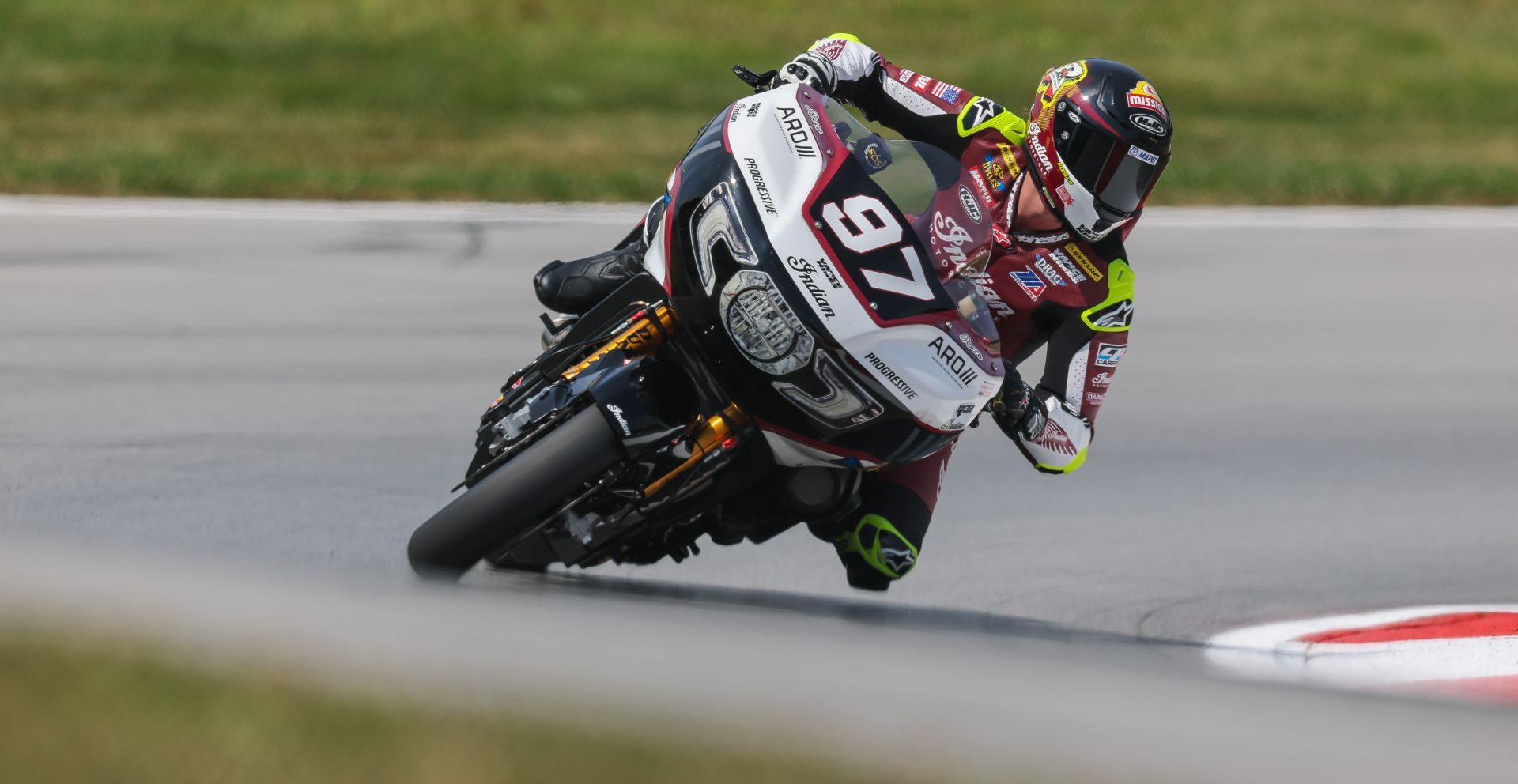
Rocco Landers won his first King of the Baggers race at COTA on a 600-pound motorcycle he'd barely touched before. That single fact tells you everything you need to know about the talent and adaptability that landed him a factory ride with Indian Motorcycle and Vance & Hines alongside Troy Herfoss and Hayden Gillim. Episode 41 of the Pipe Dreams Podcast pulls back the curtain on how a kid from Southern California who grew up chasing a MotoGP dream ended up becoming one of the most exciting names in bagger racing — and what the sport gains every time a rider of his caliber crosses over.
Who Is Rocco Landers, and Why Should Bagger Fans Care
If you've been deep in the King of the Baggers scene for a few years, you already know the names Hayden Gillim and Troy Herfoss. What you might not have followed as closely is how Rocco Landers arrived at the same factory door they walked through. His résumé reads like a MotoAmerica highlight reel: two Junior Cup championships, a Twins Cup title, time in Supersport and Stock 1000 machinery, a stint in Europe with the Red Bull MotoGP Rookies Cup racing in Italy and Spain. That's not a bagger background — that's a ground-up, corner-speed pedigree. And that's exactly what makes him dangerous on a touring machine.
The Pipe Dreams Podcast episode, hosted by Mathilde Gasnier and now streaming on Spotify, Apple Music, Amazon Music, MotoAmerica Live+ and YouTube, gives Rocco room to walk through every chapter of that career. It's 41 episodes deep, and this one lands differently because Rocco isn't a veteran reflecting on a full career — he's a young rider in the middle of the most interesting transition in American motorcycle racing.
Growing Up Racing: Stoney Landers and the Southern California Foundation
Rocco credits his father Stoney Landers as coach, mechanic, crew chief and biggest supporter rolled into one. That combination — a technically hands-on parent who understands both the mechanical side and the mental side of racing — is the kind of background that produces riders who don't panic when a setup isn't right. They diagnose. They adapt. They communicate.
For riders building performance baggers of their own, there's a lesson in that. The riders who go fastest aren't just throwing parts at the problem. They understand why a performance bagger suspension upgrade changes chassis behavior under hard braking, or why a high-flow air cleaner isn't just a bolt-on — it's the first domino in a fueling conversation you have to have with your tuner. Rocco's foundation in motorcycle mechanics, absorbed from the ground up through his father, made him coachable in ways that pure natural talent alone doesn't guarantee.
His years in Europe with the Red Bull Rookies Cup — racing in Italy and Spain, going up against the next generation of world championship talent — only deepened that foundation. He came back to America with a European development mindset applied to American machinery.
The King of the Baggers Jump: Adapting to 600 Pounds
Here's where the podcast gets genuinely interesting for anyone in the performance bagger world. Rocco talks openly about what it was like adapting to a 600-pound motorcycle after spending his formative years on lightweight MotoAmerica machinery. This isn't a small adjustment. A King of the Baggers-spec Indian Challenger isn't handling like a 600cc Supersport bike. The physics are completely different — you're leaning on the bike to turn it, not flicking it. Braking points change. Corner entry changes. The way the chassis loads and unloads through a turn changes.
And he won his first race at COTA anyway.
That performance is worth unpacking because COTA is not a forgiving track for someone still learning a new platform. The elevation changes, the technical section through turns one through five, the long back straight that demands a clean drive out of the carousel — it punishes riders who haven't yet built intuition for their machine. To win there in what amounts to a rookie bagger season is a statement.
For riders building their own Road Glide or Street Glide for street performance, the lesson from watching riders like Rocco adapt is the same one your tuner will tell you: setup matters as much as power. A bagger suspension kit that matches your weight, riding style and tire choice is going to do more for your confidence in corners than another 10 horsepower will. Power is useless if you can't put it down cleanly.
The factory Indian Challenger that Rocco races runs Vance & Hines exhaust — and for good reason. Vance & Hines performance exhaust is purpose-built for Milwaukee Eight and S&S-based touring platforms, tuned for the power band and back-pressure characteristics that big-bore bagger engines need to breathe properly at racing speeds. What works at the factory level filters down to what you build in your garage.
The Factory Opportunity: Indian Motorcycle and Vance & Hines
Landing a factory ride is the goal for every privateer who's ever strapped into a helmet and lined up on a bagger grid. Rocco's path to Indian Motorcycle and Vance & Hines wasn't linear — the podcast makes clear that the MotoGP dream he carried through his junior career didn't follow the trajectory he'd mapped out. There were detours. There were seasons where the next step wasn't obvious. There was the pressure that comes with being labeled a potential future American MotoGP star, which is a weight that can work against a young rider as easily as it works for one.
But those detours through Twins Cup, Supersport, Stock 1000 and eventually King of the Baggers gave him something a direct path never would have — genuine versatility. He's not a specialist. He's a motorcycle racer in the broadest sense of the word, and that made him exactly the kind of rider a factory program wants alongside veterans like Herfoss and Gillim.
For the performance bagger community, this factory program matters because what Indian Motorcycle and Vance & Hines develop on the race track eventually shows up in the parts catalog. Racing validates components under conditions no street test can replicate. When a Milwaukee Eight performance cam or a bagger turbo kit proves itself at race pace, that's real-world engineering data, not a dyno sheet from a controlled environment.
What King of the Baggers Racing Means for Your Build
King of the Baggers exists at the intersection of two things that shouldn't work together on a racetrack — full-size touring motorcycles and legitimate road racing speeds. The fact that it does work, and works spectacularly, is because of the development that happens when factory teams like Indian Motorcycle/Vance & Hines and Harley-Davidson/Screaming Eagle go to war on the same circuit.
Every season of that competition produces better parts for your Street Glide. Better performance exhaust systems. Better suspension calibrations. Better fueling strategies. Better understanding of how these platforms behave at the limits. When Rocco Landers wins at COTA in his first bagger season, the engineers watching from the pit wall are gathering data that eventually becomes the next generation of performance hardware.
For riders who take their Road Glide or Street Glide seriously — whether that means canyon carving, long-distance hard riding or chasing lap times at track days — the connection between what Rocco races and what you can bolt onto your own bike is more direct than it's ever been.
If you're thinking about where your own build goes next, the upgrade priorities that King of the Baggers racing consistently validates are exhaust, air intake and fueling first, then suspension, then brakes. A high-performance bagger brake kit is the kind of upgrade that doesn't show up on a dyno sheet but shows up every single time you need to scrub speed from 90 miles per hour into a technical corner. Rocco learned what those brakes feel like at race pace. You can run the same quality components on the street.
Listening to the Episode: What You'll Take Away
Episode 41 of Pipe Dreams is worth the full runtime whether you follow MotoAmerica closely or you came to bagger racing through the King of the Baggers series and haven't dug into Rocco's backstory. Mathilde Gasnier gives him room to be honest about the pressure, the detours and the moments where the career path wasn't clear. That kind of candor is rare in racing media, and the Pipe Dreams format consistently earns it.
The episode is streaming now on Spotify, Apple Music and Amazon Music. Video is available on MotoAmerica Live+, Spotify and YouTube. If you haven't already subscribed to Pipe Dreams, previous episodes with Kenny Roberts, Dallas Daniels and Cory West give you a full picture of where American motorcycle racing has been and where it's going.
For anyone building a performance bagger, watching what Rocco Landers does with a factory-spec Indian Challenger is free education. Every setup decision his team makes, every component they validate at race pace, is a signal about what works at the limit — and what you should be running on your own machine.
Build the Way the Factory Builds
Rocco Landers' first King of the Baggers win at COTA wasn't luck. It was the product of a racing education that started in Southern California, ran through MotoAmerica championship rounds and a season in Europe, and landed on a 600-pound factory machine he adapted to faster than anyone had a right to expect. That's the standard that King of the Baggers racing sets — and it's the standard your build should be chasing.
Start with what the factory programs trust: Vance & Hines performance exhaust for proper flow and power delivery, a performance air cleaner to feed the engine what it needs, and suspension that matches your machine to your riding. Shop our full King of the Baggers parts collection and bagger performance upgrades at vtwinbikers.com — because if it's fast enough to win at COTA, it's fast enough for your Road Glide.