

Hayden Gillim doesn't need a full race distance to make a statement. When the red flag flew at Mid-Ohio Sports Car Course on Saturday, August 1, 2026, the J&P Cycles/Motul/Vance & Hines Factory Indian rider was already where he needed to be — out front, unchallenged, and adding another King of the Baggers victory to a résumé that keeps getting harder to argue with. If you've been watching this series and wondering what it actually takes to build a bagger that can run at that level, Saturday's result at Mid-Ohio tells you exactly which direction to look.
Race One Results: How It Went Down at Mid-Ohio
The MotoAmerica Mission King of the Baggers Race One at Mid-Ohio was shortened by a red flag, but the order at the front was decisive. Gillim took the win for J&P Cycles/Motul/Vance & Hines Factory Indian, with teammate Troy Herfoss crossing in second — a one-two for the Factory Indian effort that underscores just how locked-in that program is right now.
Third went to James Rispoli aboard the Big Diehl x Harley-Davidson Factory Racing machine, which means the Milwaukee iron was competitive enough to stand on the podium but couldn't quite crack the Indian stranglehold on the top two positions. Fourth went to Factory Indian's Rocco Landers, making it three Indians in the top four. Tyler O'Hara of SDI Racing rounded out the top five.
For anyone keeping score at home: Indian placed first, second and fourth. Harley-Davidson got third. The competition between these two American V-twin platforms is exactly what King of the Baggers was built around, and Mid-Ohio delivered.
What the Factory Bikes Tell Us About Performance Bagger Direction
These factory efforts aren't just racing for trophies. They're rolling development labs, and every lap run at Mid-Ohio filters down into the parts and tuning knowledge that ends up on YOUR bike in the garage. The exhaust systems, the suspension calibration, the airflow work — it all starts here.
Vance & Hines has been a cornerstone of the Factory Indian effort from the beginning, and their presence on podium-winning machines isn't accidental. If you're running a touring rig and you haven't addressed your exhaust yet, you're leaving power and character on the table. A proper performance exhaust system is the single highest-impact bolt-on change you can make on a Milwaukee Eight or Indian PowerPlus platform — better flow out means the engine breathes better in, and that means more usable power everywhere in the RPM range.
The factory teams pair those pipes with dialed-in high-flow air cleaners because the intake and exhaust sides of the equation work together. Restricting one while freeing the other is a half-measure. The machines running at the front of the King of the Baggers field are optimized as complete systems, and your build should be too.
Rispoli's Third: What Harley-Davidson Factory Racing Brought to Mid-Ohio
James Rispoli putting the Big Diehl x Harley-Davidson Factory Racing machine on the podium in third is significant. Harley-Davidson's factory program has been pushing hard to close the gap, and landing on the box at a technical track like Mid-Ohio — a circuit that demands chassis balance, braking stability and corner-exit drive — shows the work being done at the factory level is paying off.
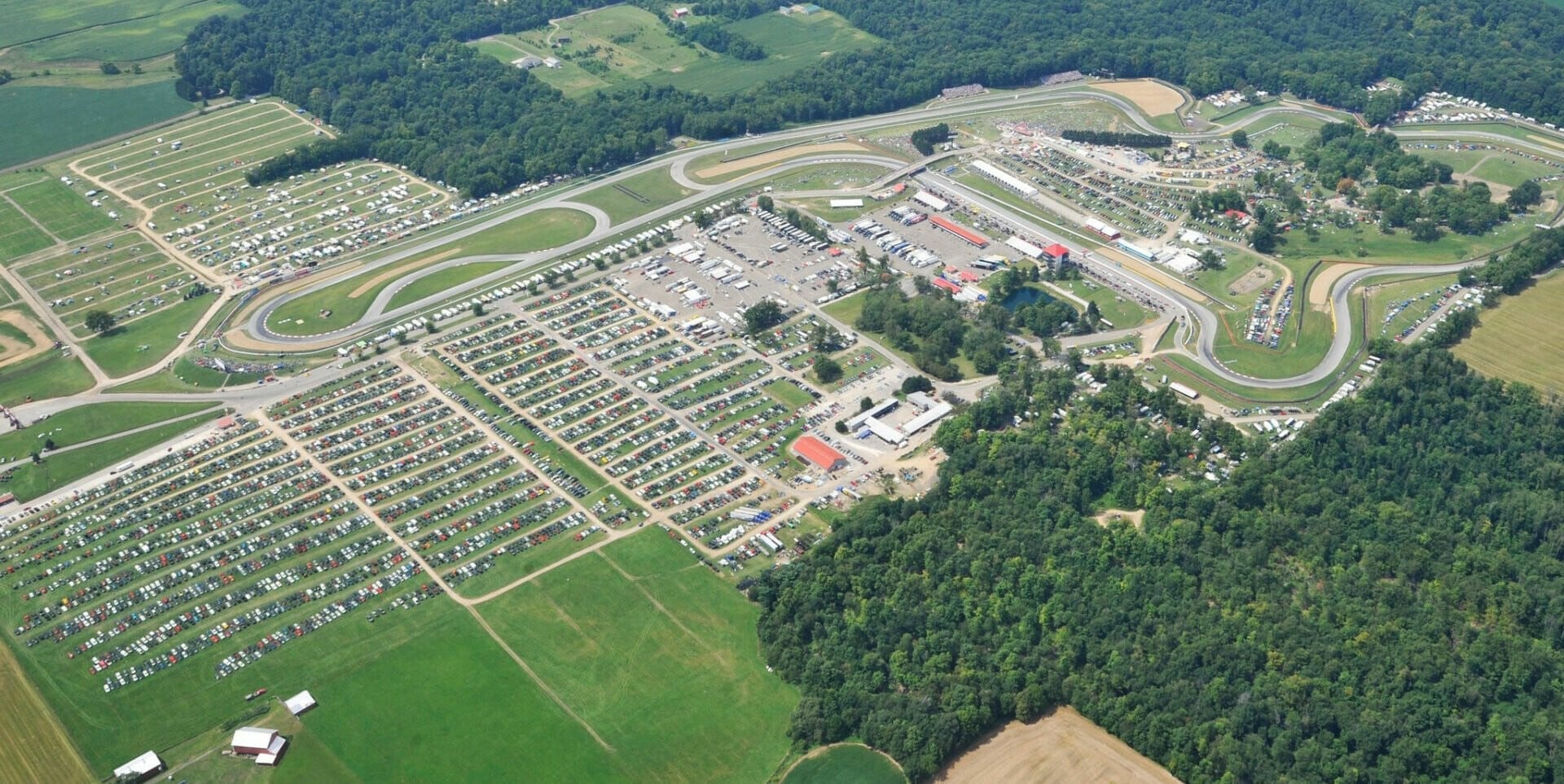
Mid-Ohio is not a flat-out bagger-friendly oval. It's got elevation change, a carousel section that loads the chassis hard and several braking zones where stability and suspension tune matter enormously. Running a bagger competitively on that layout requires more than raw power — it requires race-calibrated suspension that can handle the compression and rebound demands of a heavy touring chassis being pushed to its absolute limits.
For YOUR Road Glide or Street Glide, that same principle applies. Factory suspension on most touring bikes is set up for rider comfort over a wide range of conditions — which means it's compromised for performance. Upgrading to quality aftermarket suspension front and rear transforms how the bike responds to YOUR inputs, particularly in aggressive cornering and hard braking situations.
The Red Flag Factor: Racing Shortened, But Results Stand
The red flag that shortened Race One doesn't change the outcome — Gillim won, and the results are official. Red-flag situations are part of road racing, and the order at the time of the stoppage is what counts when a race is deemed official. The riders at the front earned their positions, and Gillim's win stands as clean.
What's worth noting is how the race unfolded before the stoppage. Having Landers in fourth alongside Herfoss in second shows the Factory Indian operation is running three competitive machines capable of podium results — that's team depth that puts enormous pressure on the Harley-Davidson effort and on independent runners like Tyler O'Hara's SDI Racing machine, which has been a consistent threat throughout the season.
O'Hara finishing fifth keeps SDI Racing relevant in the championship picture. Independent programs in King of the Baggers operate without the full factory budget, which makes their results even more impressive and proves that smart tuning and development can compensate for some of the resource gap.
Engine Performance: The Arms Race Under the Fairings
King of the Baggers has turned into an engine displacement and power arms race in the most entertaining way possible. The rules framework allows significant engine modification, and the teams have taken full advantage. What the factory bikes are running under those fairings represents the cutting edge of what V-twin torque-curve engineering can produce.
For YOUR build, the road to more power runs through a few well-established checkpoints. Camshaft selection is where serious Milwaukee Eight builders start because the factory cam profiles are conservative — built for emissions compliance and broad market appeal, not for peak output. A properly spec'd performance camshaft for your M8 107, 114 or 117 opens up the power band in ways that supporting modifications can then capitalize on.
Once you've addressed cam timing and valve lift, your fueling needs to be retuned to match. This is where a quality fuel management tuner becomes essential — not optional. Running a modified engine on factory fuel maps is the fastest way to kill the gains you just paid for. Whether you're using a standalone tuner or going to a professional dyno tune, getting the fueling dialed in is what separates a properly built performance bagger from a pile of expensive parts that don't work together.
For riders looking at a more substantial power addition, forced induction is where the King of the Baggers factory teams have been increasingly focused. A bagger turbo kit changes the entire power conversation — you're no longer fighting the displacement limitations of a naturally aspirated V-twin, you're multiplying what the engine can produce with every pound of boost. The installation is more involved, and the supporting modifications required are more extensive, but the results are in a different category entirely.
Braking, Tires and the Dunlop Connection
Dunlop's Sportmax Slicks are the official tire of the MotoAmerica Series, and their involvement in King of the Baggers reflects how seriously the tire technology side of this class has developed. The loads a bagger puts through a tire — particularly during hard braking with a heavy chassis — are significant, and the tire technology that supports the factory teams at Mid-Ohio is the same technology informing street performance tire development.
For YOUR bike, upgrading to quality performance brake components is the braking-side equivalent of the suspension upgrade conversation. Factory brake setups on touring bikes are adequate for street use, but if you're running aggressive canyon roads, track days or just want the confidence of shorter stopping distances, aftermarket rotors, calipers or brake pads make a real and measurable difference.
Braking stability at Mid-Ohio — with its elevation changes and hard turn-in points — depends on both the tire compound and the brake system working together. On YOUR street build, the same logic applies: tires and brakes are a system, and upgrading one while ignoring the other is a missed opportunity.
What Mid-Ohio Race One Means for the Championship
With Gillim taking the win and Herfoss in second, the Factory Indian effort has reinforced its position at the top of the championship standings. Rispoli's third keeps the Harley-Davidson factory program in the fight, and O'Hara's fifth confirms SDI Racing isn't going anywhere. Race Two at Mid-Ohio will tell us more about whether these positions reflect settled pace or whether the gaps can be closed under green-flag racing conditions with no red flag to lock in the order.
For the performance bagger community, every race weekend at a technical circuit like Mid-Ohio generates real data — suspension settings, power delivery characteristics, brake bias, tire behavior — that feeds back into the development of the parts you can run on your own machine. This is the direct line between what you see on the podium and what ends up making YOUR bagger faster and more capable on the roads you actually ride.
If Gillim's win at Mid-Ohio has you thinking seriously about YOUR build, start with the fundamentals: exhaust flow, intake, fueling and suspension. Those four categories represent the biggest gains per dollar on any Milwaukee Eight or V-twin touring platform, and the factory race teams validate that priority list every single weekend they line up on the grid.
Shop our performance exhaust systems and bagger suspension upgrades at vtwinbikers.com — everything your build needs to close the gap, one proven component at a time.